









As showcased so far, the fundamental approach to manufacturing at Daicel comprises infrastructure improvement, standardization, and systematization steps.
AI has been applied at the systematization step in operational management at chemical plants, leading to creation of the Autonomous Production System built with the PCM (Plant Capability Maximizer) and APS (Advanced Prediction System).
As the next step, the introduction of this approach to production management is in progress.
When formulating production plans for chemical plants, the current situation is that, unlike manufacturing, many aspects still rely heavily on the know-how of seasoned operators, and a vast number of constraints must be considered. By establishing the information infrastructure needed to assess constraints and distilling the judgment criteria in the minds of seasoned operators into explicit knowledge, a mechanism is being built that is capable of automatically formulating optimal production plans according to market conditions and company circumstances.
Furthermore, this approach can be applied to equipment management at chemical plants.
A key challenge lies in how to standardize and systematize processes that previously relied on the human senses. In equipment management at chemical plants, there are in fact many cases where people monitor conditions and detect abnormalities through the five senses, such as sight, smell, or touch. To address this, decision-support mechanisms are being considered that utilize sensing technologies as alternatives to the five senses, starting with cameras. The resulting data is analyzed to pinpoint the causes of abnormalities and propose appropriate countermeasures.
Currently, we are working to build a mechanism in which AI-operated robots autonomously acquire and analyze inspection data based on the five human senses for daily inspections and maintenance of manufacturing equipment performed by people.
This initiative aims to improve the speed and precision of five-sense inspections while accumulating data that captures human expertise. Furthermore, it will confirm whether appropriate inspections and management can be performed remotely without the need for personnel to visit the production floor, thereby ensuring worker safety.
Robots allow inspections to be performed remotely regardless of distance or weather, enabling continuous point management to constantly monitor areas that previously could only be visually inspected once a day by people walking the floor. In addition, with AI assistance, the System makes it possible for everyone to excel, regardless of their level of experience or physical strength. An aim of this technology is to contribute to promoting the employment of people with disabilities and elderly individuals with seasoned skills. This is one of the specific initiatives for realizing the happiness of our employees (Sustainable People) in the Daicel Sustainable Management Policy.

Introduction of the Autonomous Production System approach not only to operational management at chemical plants but also to production management and equipment management will enable manufacturing to evolve further.
At Daicel, we will expand the Autonomous Production System beyond the boundaries of our own product chains.
The Autonomous Production System will continue to evolve into the next generation of production systems as a means of transforming manufacturing by reading market and customer needs and translating them into a form that can be implemented on the production floor.

Daicel is also pursuing technological innovation for chemical plants themselves.
One such innovation is Micro Plants, a microfluidic device technology that realizes massive chemical plants at desktop scale.
-

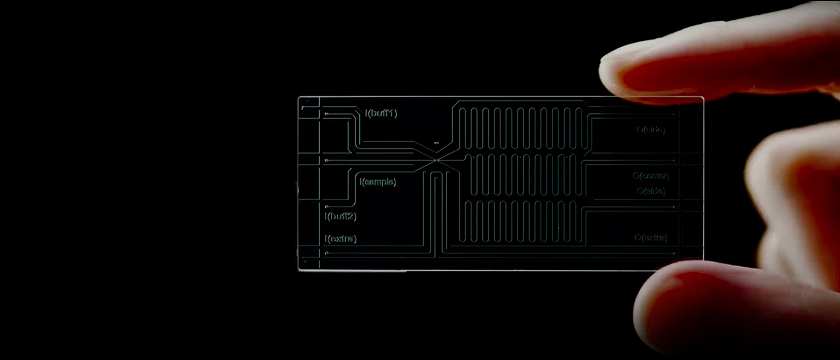
A single unit is constructed by connecting together business-card-sized glass plates. Any chemical product can be handled by combining different glass plate flow path designs, and production can be scaled up by adding parallel units. Furthermore, when industrializing laboratory results, reproducibility can be achieved simply by increasing the number of glass plates, which accelerates the transition to commercial-scale startup.
-

In ultrafine flow paths, it is possible to generate targeted reactions with pinpoint precision and speed, with uniform temperature and pressure. Since wasteful reactions are less likely to occur, product purity is high, eliminating the need for downstream processes to separate undesirable components. When implemented in a resist polymer manufacturing plant, it is expected that both energy consumption and CO₂ emissions can be reduced by more than 90%.
-

Because it is possible to construct ultra-small, ultra-low-energy, low-cost equipment, the Micro Plant drastically increases the flexibility of production facilities. By locating production facilities near raw material sources, local production for local consumption becomes easier, and the cost and energy required for transportation can be reduced significantly.


We will continue to be a company
where both people and chemical plants keep growing,
unbound by conventional assumptions.

