











Daicel’s Autonomous Production System is based on Daicel Production Innovation, which has optimized the operation and management of entire plants while achieving dramatic improvements in productivity, and further evolving through the use of proprietary AI. By bringing innovation to both the way manufacturing is carried out and the way people work on the production floor, the Autonomous Production System creates new added value. Here, we introduce the system in detail, presenting its full scope.

Announced by Daicel in 2020, the Autonomous Production System evolves Daicel Production Innovation (completed in 2000) through the introduction of AI and assists manufacturing sites at chemical plants in reaching optimal solutions. By introducing proprietary AI jointly developed with the University of Tokyo based on Daicel Production Innovation, the accuracy of monitoring and predictive forecasting systems for ensuring safety and stable operation has been improved, resulting in significant reductions in production costs.
The source of a manufacturing company’s competitiveness lies within its production sites. Massive chemical plants are complex entities, much like large living organisms, with a variety of manufacturing equipment interconnected by piping and operating conditions constantly changing. Furthermore, the state of production cannot be seen from the outside. In the process of controlling these chemical plants to ensure safety and quality while pursuing low-cost operations, the know-how of seasoned operators has been accumulated.
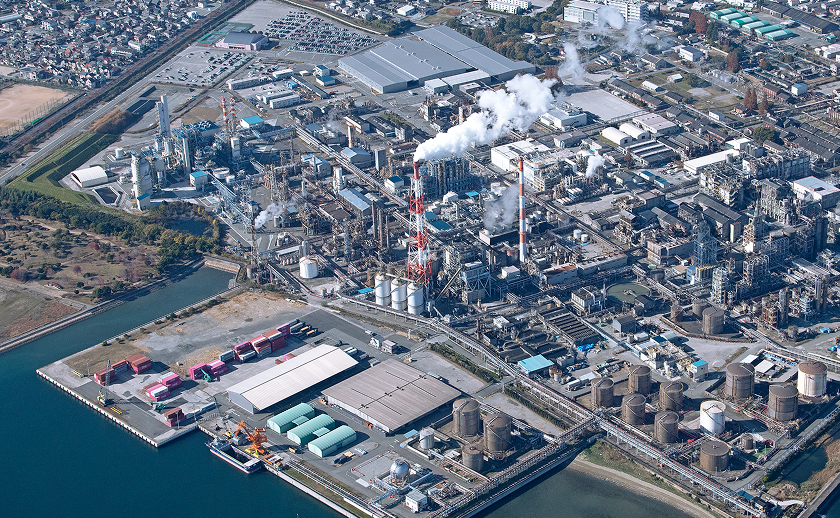
Himeji Production Site, Daicel Corporation
The Autonomous Production System assists operators by incorporating AI that continuously learns from data collected daily at chemical plant manufacturing sites. The integrated AI leverages past operational know-how while continuously extracting new know-how from daily operations. By assigning the collection and analysis of accumulated know-how to the AI, people can break free from the vast amount of time previously required for data collection and past analytical work, allowing them to concentrate on more creative work, such as improving know-how, identifying gaps in site management, and finding optimal solutions. In addition, feeding these insights back into the AI contributes to further AI evolution.
Daicel’s Autonomous Production System is not merely an IT tool that makes full use of AI. It creates connections in which people and machines influence and interact with each other; people foster the growth of the machines, and those who use the machines grow even more. This is the kind of system we are designing.

| Autonomous | By utilizing machines, people grow and achieve self-actualization. |
| Model | The current state is merely one model. We will continue to upgrade this version in the future. |
| System | This refers to the overall connected process of noticing, thinking, and taking action (the computer system is positioned as a tool to achieve this). |
Daicel’s Autonomous Production System is a framework that enables both people and systems to grow autonomously, with the goal of sharing with society the fulfillment people derive from engaging in more creative work.

On this page,
an easy-to-understand overview of concepts and initiatives Daicel is advancing for the Autonomous Production System, as well as the future beyond it,
is presented through the following five chapters.
-


Why was the Autonomous Production System created? An overview of the system is provided here, focusing on the background and objectives behind its development.

-

What are the AI applications unique to the Autonomous Production System, which differ significantly from conventional AI methods like deep learning?
-

People foster the growth of the machines, and those who use the machines grow even more. The new growth cycle emerging at manufacturing sites is explained here.
-


The implementation scope of the System extends beyond manufacturing sites. The path toward achieving even higher quality and efficiency is explained here.
-

The vision of the future that emerges by introducing the Autonomous Production System approach to production planning and facility management is explained here.


Within supply chain collaborations, there are social challenges that a single company cannot solve alone (such as environmental initiatives and supply chain disruptions due to geopolitical risks). As a manufacturing company, Daicel recognizes that success cannot be achieved by focusing solely on its own interests; initiatives are needed that improve and benefit the entire supply chain. The Autonomous Production System breaks down social issues into what we can do as a company, then further into what each site can do on its own, and finally into the tasks of each and every person on the production floor.
Daicel is expanding the implementation scope of the Autonomous Production System from manufacturing sites to production planning and logistics, aiming to achieve coordinated manufacturing throughout entire supply chains rather than just within individual companies. This approach represents the virtual company concept, a new form of broad corporate collaboration without business combinations. By synchronizing manufacturing data across company boundaries throughout the supply chain, we will establish a system capable of producing the right amount of products when they are needed. Such initiatives not only improve production efficiency and product quality but also contribute to reducing excess inventory, associated energy consumption, and production and logistics costs.
The VVCC (Virtual Value Chain Control Center), currently at the conceptual stage, will serve as the hub for integrated management of such virtual companies. Daicel is already linking production data from its Aboshi Plant (Hyogo Prefecture) and Otake Plant (Hiroshima Prefecture) in real time, treating them as a single integrated plant. This is realization of the virtual factory concept, with optimal production planning and energy supply and demand across both sites. By establishing the VVCC, Daicel will expand the scope of this optimization beyond its own plants to the entire supply chain, bringing the virtual company concept to life.
The Autonomous Production System accelerates dialogue among companies connected across the supply chain and translates market needs into production. By rapidly incorporating these needs into the manufacturing process, the System will accelerate the growth of new businesses and evolve into a means of bringing new value propositions to society.


