
The Daicel Group formulated our long-term vision targeting fiscal 2030. As a means of implementing this vision, our Group also formulated a Mid-Term Management Strategy. With this innovative vision and strategy as our new guidelines, we are focused on responding with flexibility to a variety of issues related to the international community and the global environment. These issues include shifting social circumstances as well as the rapid technological progress arising from the widespread adoption of artificial intelligence (AI) and the internet of things (IoT). Through these business initiatives, we will contribute to the emergence of a society committed to sustainability while pursuing the ongoing growth of the Daicel Group.
The Path to Implementing Our Long-Term Vision
As we remain focused on the well-being of our employees and the sustainability of our products and manufacturing processes, we aim to provide the value demanded by society as we contribute to human happiness and the emergence of a society committed to recycling. To this end, we intend to expand the scope of our value co-creation to encompass Daicel itself, our Group companies, and our business partners and customers who are linked through the supply chain. In this way we will provide society with greater value than a single company alone could offer.
At the original Daicel (OP-Ⅰ), in addition to maintaining our current business, we will transform our corporate structure and promote an "asset-light" approach emphasizing comprehensive cost reductions, particularly in the domains we focus on.
Under the new Daicel (OP-Ⅱ), we will work to expand our business domains through mergers, acquisitions, and alliances in areas related to our existing businesses; reorganize existing businesses; and fundamentally review joint ventures with the aim of transforming the entire Group into an exceptionally asset-light entity.
Our new corporate group (OP-Ⅲ) seeks to provide value that extends beyond the scope of the Group by first strengthening our vertically integrated value chain (supply chain), working on value creation (co-creation) for our respective customers, and expanding co-creation horizontally with other companies in the same industry as well as universities.
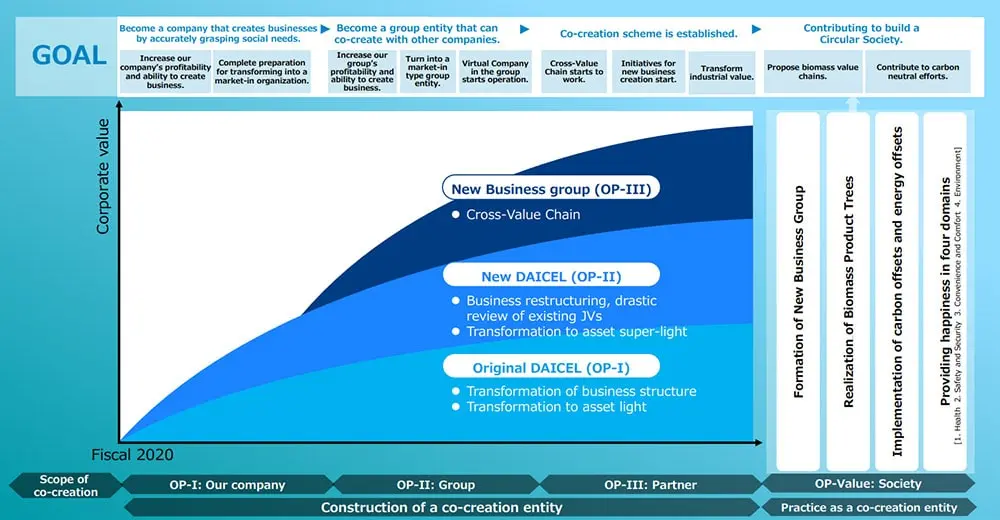
In addition, in order to achieve the goal of our long-term vision of "Contribution to Building a Circular Society", we intend to implement the "four transitions" that will significantly change how we forge society.
Formation of a New Business Group (Value Co-Creation Entity)
We will expand the value co-creation scope from Daicel Corporation (non-consolidated) to the Daicel Group (consolidated) and then include our partner companies as well. Beyond the boundaries of departments and companies, industries, academia, and governments, we will share the same aspirations and strive to create value together.
Realization of Biomass Product Trees
We are developing the technology for melting wood at room temperature and under normal pressure conditions. By utilizing dormant forest resources in Japan as a renewable resource, we will create new product trees where both products and manufacturing processes are environmentally-friendly.
Click here for Details of the Biomass Value Chain Concept
Implementation of Carbon Offsets and Energy Offsets
We will conserve energy through production process innovation. Also, we continue to develop technologies that enable reuse and efficient utilization of emitted carbon while maximizing our competitive advantage in manufacturing as we improve productivity, reduce costs, and minimize environmental load.
Provision of Happiness in Four Domains
Our competitive advantage in these domains (Health, Safety/Security, Convenience/Comfort, Environment) allows us to respond to the social trends and increasing needs.
By leveraging our unique materials and technologies we have cultivated since the founding, we will continue to create and deliver new value.
Mid-Term Management Strategy
In the previous mid-term management strategy, Accelerate 2025, we aimed to realize our basic philosophy by providing value through the strengthening and growth of existing businesses and by contributing to building a circular society. In the mid-term management strategy, Accelerate 2030, we will continue these efforts while giving top priority to resolving the various issues that became apparent during the period of Accelerate 2025, and we will clarify our new growth vision.
Mid-Term Management Strategy “Accelerate 2030“
Company-wide Performance and Management Indicators
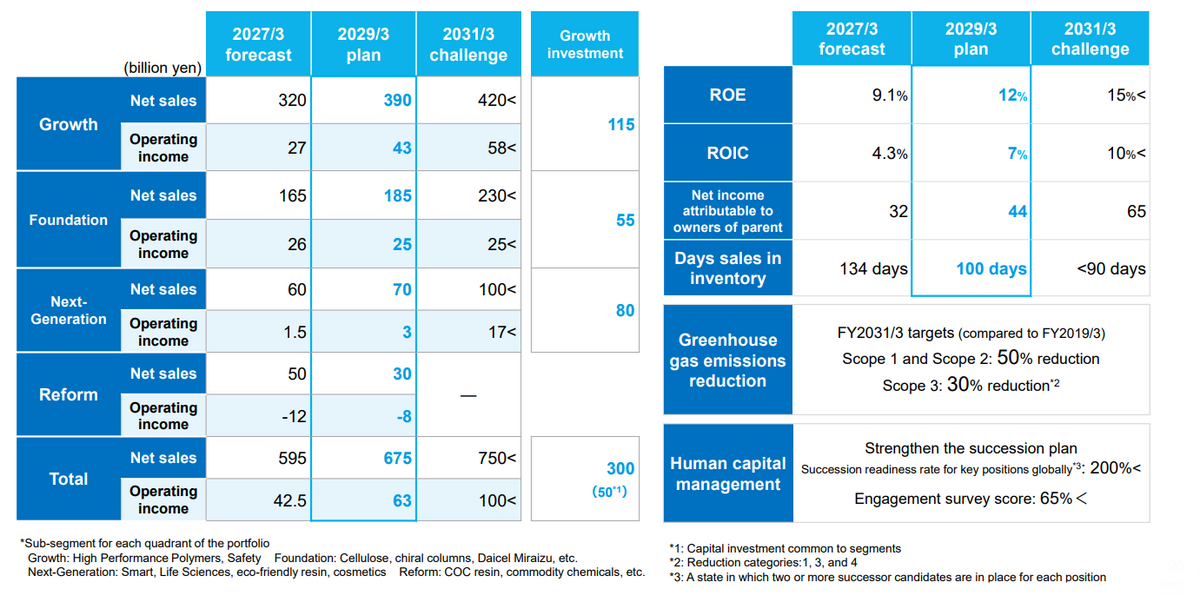
In Accelerate 2030, the fiscal year ending March 2029 is positioned as an important year toward achieving our goals, and interim targets have been set. Together with the fiscal year ending March 2031, the final year of the plan, the following company-wide performance figures and management indicators have been established as targets.
Company-wide Performance:
FY2029/3: Net sales 675 billion yen / Operating income 63 billion yen / Net income attributable to owners of the parent 44 billion yen / EBITDA 120 billion yen
FY2031/3: Net sales 750 billion yen / Operating income 100 billion yen / Net income attributable to owners of the parent 65 billion yen / EBITDA 170 billion yen
Management Indicators:
FY2029/3: Operating income margin 9.3% / ROE 12% / ROIC 7% / ROA 5% / Reduce days sales in inventory to 100 days
FY2031/3: Operating income margin 13.3% / ROE 15% / ROIC 10% / ROA 7% / Reduce days sales in inventory to 90 days
-
Shareholders return policy: Starting from FY2027/3, the dividend policy will be revised to target a DOE (Dividend on Equity) of 5% or more and a total payout ratio of 60% or more.
Portfolio Management
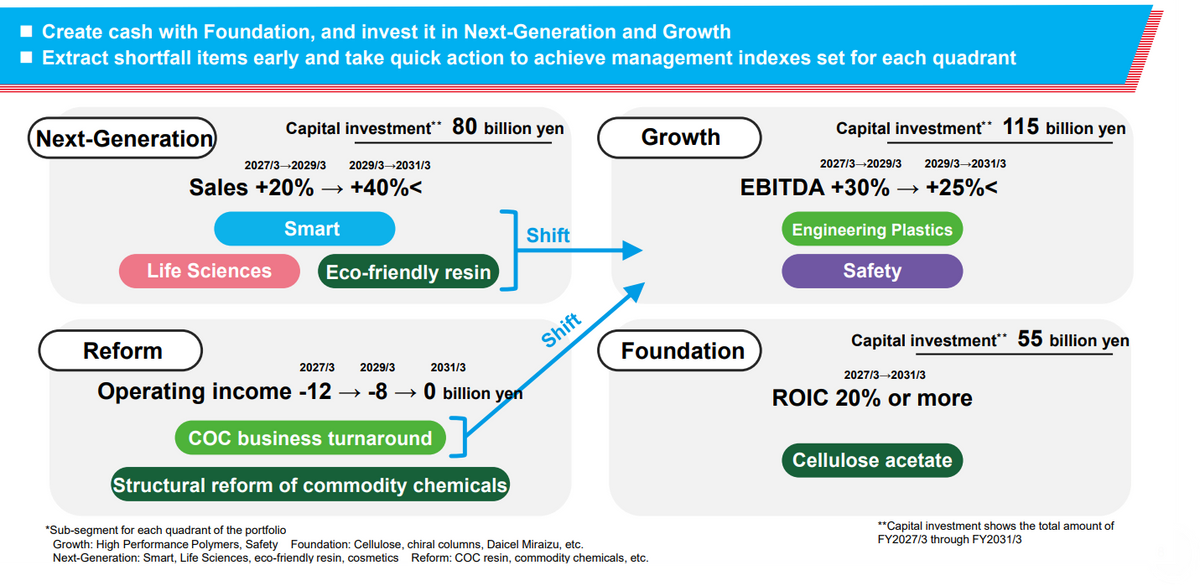
We will further strengthen business portfolio management and, through optimal resource allocation and swift actions, increase the share of both net sales and operating income contributed by the “Next-Generation” businesses and the “Growth” businesses.
Portfolio Management
Numerical Targets
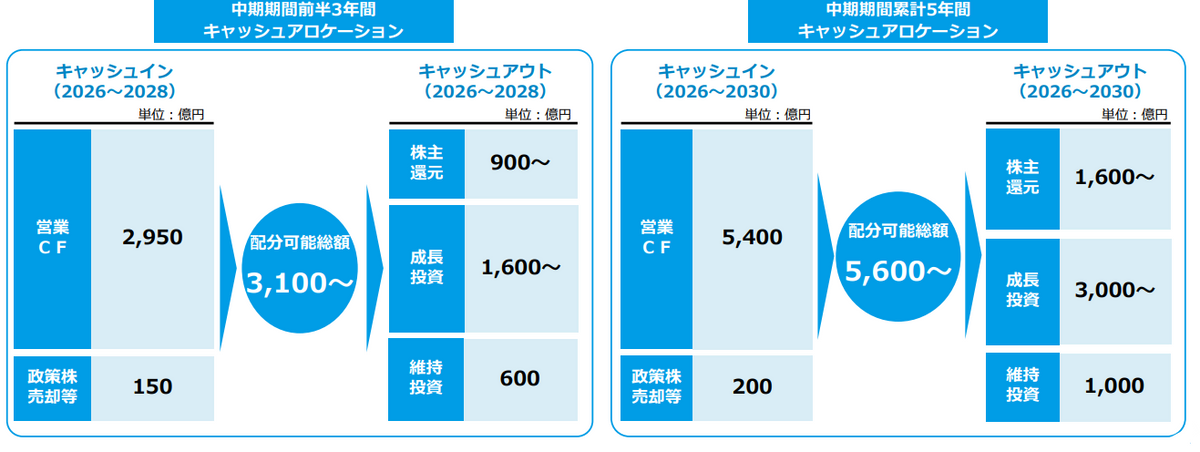
Cash Generation Capability
We will focus on expanding top-line growth by allocating more than 50% of cash flow to growth investments, including environmental initiatives. In addition to strengthening profitability, we will improve cash generation capability through reductions in the cash conversion cycle, including proper inventory optimization. We will also further enhance cash generation capability through measures such as the sale of strategically held shares, and use surplus funds for growth investments and shareholder returns. We target a total payout ratio of 60% or more for shareholder returns and will respond flexibly, including through share buybacks.
References
- Mid-Term Management Strategy “Accelerate 2025-Ⅱ(Updated)“ (May 11, 2023)
- Mid-Term Management Strategy “Accelerate 2025-Ⅱ“ (Feb 17, 2021)
- Mid-Term Management Strategy “Accelerate 2025 “(June 8, 2020)
- The Fourth Long-Term Vision “DAICEL VISION 4.0 “(June 8, 2020)