
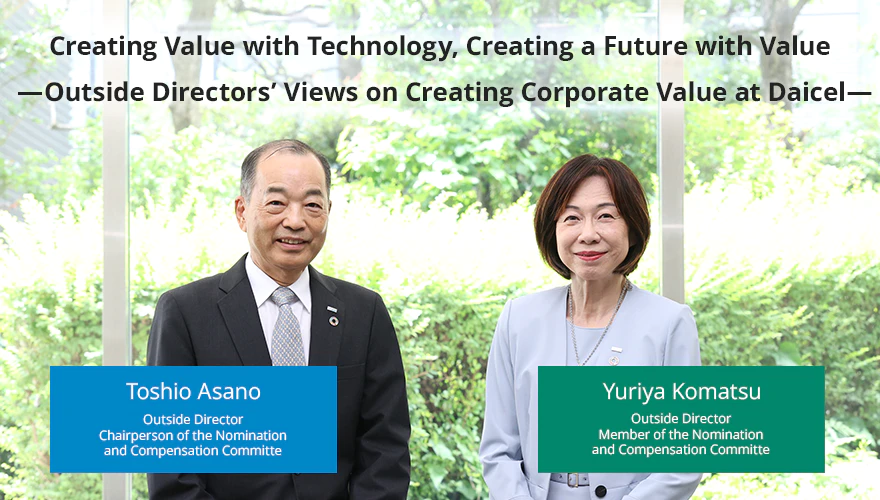
Daicel Group has formulated its Mid-Term Management Strategy “Accelerate 2030” with the aim of solving social issues and achieving sustainable growth while meeting new challenges. Outside Directors Mr. Asano and Ms. Komatsu discussed the Daicel Group’s strengths and challenges, as well as the Company’s path toward corporate value creation through FY2031/3.
Q. Both of you have been observing Daicel as Outside Directors for several years, so what are your impressions of Daicel from the time you assumed your positions until the present day?
- Asano:
- I have been with a chemical manufacturer for over 30 years, involved with both the manufacturing plants and the research facilities. For that reason, when I look at a company, I first look at its plants. That’s because I can see what a company is like if I go to its plants. When I toured Daicel’s plants, my impression was that it was a good company. I could see that the kind of culture you can’t build in a day—a culture of organization, improvement programs, and consideration for safety—was deeply rooted in the workplace.My impression has not changed since then.
- Komatsu:
- I have the same impression of the workplace. I’ve visited a lot of plants, and Daicel’s plants are well managed. All the employees have positive attitudes, so my impression was that it is a carefully managed company. Its Long-Term Vision is clear, and with its concept of corporate growth leading to improved social value, I feel that its policies are being implemented with a steady hand. Workplace management, the employees’ positive attitudes, and the efforts based on the Company’s Long-Term Vision, all form an integrated whole. I believe that is what makes Daicel such a great company.
Q. Where do you think Daicel’s competitiveness and strengths lie? How do you view the Company’s possibilities in terms of technology, human resources, and collaboration?
- Asano:
- From a technological perspective, I would first point to the acetyl chain, including cellulose. This is one of Daicel’s greatest strengths, even when viewed globally. Another is the connection between human resources and technology. Daicel’s history is one of developing from mergers of several companies, and the attitude of valuing one’s human resources was handed down through that process. I think that it is precisely because of that culture that the Company can continue to improve and refine various technologies.
- Komatsu:
- I feel that, in addition to the technologies themselves, a major strength is structures for making use of these technologies. For example, digital transformation, or “DX” is an iconic effort. Now there is a lot of attention being paid to DX in manufacturing plants, but even twenty years ago, Daicel was visualizing production processes and gathering and making use of data to build its own unique production methods. The way the Company takes this knowledge and extends it to other plants and businesses is a major strength. A further feature is having the seeds for a variety of technologies. And it’s not just a matter of individual technologies but a question of how to link these technologies and develop them into new businesses and new value. I believe that combining technologies will lead Daicel into its next phase of growth. I place a high value on the potential for that happening.
- Asano:
- It is no simple matter to link up two different technologies. In order to make that happen, it’s important to have close communication within the Company. A company knows whether this kind of linkage has succeeded when some sort of problem occurs. For example, when issues arose in Daicel’s carbon monoxide plant, not only the technological departments but the whole Company, including the management team, got involved in making improvements. Seeing that approach, I feel that this is a company that successfully promotes cross-functional collaboration.
Q. It seems that some people call Daicel “a company that is hard to understand,” but how do you view its evaluation by the capital markets?
- Asano:
- Nowadays, with the PBR remaining below 1.0, I think we first of all need to accept the market valuation in good faith. Of course it is important for Daicel to make efforts to be understood, but since institutional investors and analysts have made their current assessments based on continuous analysis, so we must not forget that they have made this appraisal through their understanding of the Company. For that reason, in order to have the market appraise Daicel more favorably, it will be essential to improve the quality of our management further.
- Komatsu:
- What I take more seriously than the PBR is that the PER remains at approximately 10. I perceive this as a sign that market expectations for Daicel’s future growth have not yet been fully reflected in its valuation. What is important is indicating a specific path leading to growth. It is essential to demonstrate to the market a cycle in which Daicel maintains and strengthens one of its key strengths—its businesses that generate stable cash flow—while reinvesting the cash they generate in growth areas to develop new pillars of growth.
- Asano:
- I agree. Daicel has developed a wide variety of technologies over the years, including materials technology and production technology. However, that alone will not lead to improved corporate value. What is required is a combination of these strengths, leading to new businesses and new value.
- Komatsu:
- That is exactly what the investors want to know. “What is your next pillar?” “How will that business lead to profit?” If this growth story emerges in specific terms, the market assessment ought to change, too. According to “Accelerate 2030,” how will Daicel bring about these new businesses and growth in the existing businesses? Isn’t it important to clearly indicate the path?
- Asano:
- In order to do that, it will be essential for research, business, technical services, and production sites to join forces and create systems for solving clients’ issues. We should not coast on our past successes but challenge ourselves to work on new technologies and find new markets. I expect that meeting those challenges will lead to making “Accelerate 2030” a reality.
Q. In your position as an Outside Director, which of your roles do you consider most important?
- Asano:
- Making decisions in place of the management team is not the role of an Outside Director. My role is to make use of my previous experience and ask repeatedly “Is this really the way you should go?” For example, based on my experience at Asahi Kasei, I have a real sense of the importance of integrating businesses and creating synergies. At Daicel, I took an active approach to stating my opinions about things like the integration of Polyplastics. Also, we not only need to start new things but also to decide to give certain things up, if necessary. If you take on three new challenges, you should discontinue one existing initiative. If you can’t resign yourself to giving up certain things, you’ll end up scattering your management resources. I often convey that message to the Directors.
- Komatsu:
- I share the same view. As I look back over the years since I assumed this position, I see that Daicel has taken a steady approach to reassessing its business portfolio. There were some large-scale investment projects that didn’t go according to plan. For instance, with regard to the carbon monoxide plant and the COC resin plant, we not only discussed how we should rebuild them but also considered whether we should continue these businesses and whether we had looked at all the options, including withdrawing from those businesses. The question is not how much we invested in those areas in the past but whether they can improve corporate value. I think it’s important to make decisions on that basis.
- Asano:
- Before that, it is important to investigate thoroughly to find out why something didn’t go according to plan. We should not focus only on technology but also analyze the causes of the issues in terms of investment decisions and awareness of risk, and then we should make use of that knowledge. That kind of layering leads to improvements in management.
- Komatsu:
- Our roles as Outside Directors include that, too. When problems arise, we sort out the causes and check to see whether mechanisms for risk management and monitoring are sufficient. It’s also a matter of making suggestions about how the experience can be effectively applied to the next investment decision. But it’s the executives who make the final decisions and execute them. However, we want to ask direct questions from an outsider’s point of view and provide encouragement for decision making that will improve corporate value.
Q. As Outside Directors, how do you evaluate the Board of Directors and company governance?
- Asano:
- I am aware that the Board of Directors has achieved a rather high level of effectiveness. Even if Outside Directors state their opinions directly, there is no resistance from the management team. We sincerely listen to one another as we discuss matters. In the area of governance, there is still room for more intense discussions about long-term human resources systems and a vision for the organization and other core concerns.
- Komatsu:
- In discussions at the Board of Directors meetings, the Outside Directors take an active role in speaking up, and the Company Directors also carefully take what we say under consideration. Some ideas can be implemented quickly, while other matters, like reassessing systems, take a long time, but I feel that they are definitely reflected in the way management operates. Our role is not to give detailed instructions on how management should execute its responsibilities. What is important is to check continually to see what has become of a suggestion and to keep asking about it, if necessary. Also, I think that having multiple layers of monitoring raises the effectiveness of the Board of Directors and improves governance.
Q. The Mid-Term Management Strategy “Accelerate 2030” contains suggestions for co-creation, M&A, and growing new businesses. What are your expectations for this Mid-Term Management Strategy?
- Asano:
- The expectations are clear. They are to create one or two businesses that will show major growth, choosing from among the themes designated as growth areas. Daicel has developed a wide variety of technologies over the years, including materials technology, production technology, and processing technology. Combining these technologies and pioneering new markets will be a major focus in the new Mid-Term Management Strategy.
- Komatsu:
- In addition, Daicel should not go it alone in these growth areas. Instead, it will be important to make use of options for co-creation, M&A, and joint ventures. To accomplish that, we will need to move forward not only on our strengths in relation to our competitors but alsoask ourselves what we can offer to our partners. Daicel will be required to become a company that can acquire skills and attitudes different from those in the past and join together to create new value.
- Asano:
- Issues that cannot be solved with one material alone can give rise to new solutions based on combinations of different technologies. It will be important to incorporate technology and knowledge, not just from Daicel but from other companies also to create new value.
- Komatsu:
- I think that it will be necessary to change the ways of thinking about new businesses. If we simply patch together small-scale businesses, there will be limits to how much the Company can grow. If we look ahead to major markets and large businesses, it will be necessary to concentrate management resources from the beginning. There are many kinds of research and development. We should look at each one and ask “How could this be made to flourish?” as we grow our businesses. That concept is essential for making “Accelerate 2030” a reality.
- Asano:
- Asano: I think so, too. Daicel’s strength is its technology, its people, and its corporate culture of continuous improvement. We can make use of this as we challenge ourselves to develop new markets and businesses. I’m thinking that these layers of corporate culture will lead to the realization of “Accelerate 2030.”
Q. They are practicing the kind of management that emphasizes capital efficiency. How do you evaluate ROIC, and what kind of management will be required going forward?
- Asano:
- I think that it is extremely important for Daicel as it exists now to focus on ROIC. Yet if they think solely about improving ROIC and give up on investing, their numbers will improve. However, if they do that, there will be no growth in the future. Even if you are aware of capital efficiency, it is important to continue making investments that will lead to growth ten years from now. I think that maintaining that balance is one of the difficult parts of management.
- Komatsu:
- Capital markets view raising ROIC as important, but that is not the only objective. The Company is asked to generate earnings above its capital costs while continuing to make investments that will lead to sustainable growth. I hope that an emphasis on ROIC will result in a company where each employee is aware of balance sheets and cash flow.
- Asano:
- In order to raise ROIC, just optimizing each department will not be sufficient. To attain a balance between investment in new businesses and existing businesses, the entire Company will have to consider the matter of optimal resource allocation.
- Komatsu:
- That is very important. For example, ROIC improves if you reduce inventory, but then you lose opportunities for sales, so there’s no sense in doing that. We need to look beyond optimizing individual departments and focus on the optimal allocation of resources across the Company as a whole. Furthermore, the roles required for existing businesses and growth businesses will be different. Instead of evaluating all of them according to the same criteria, it will be important to allocate capital to them on the basis of their respective roles in the Company.
Q. What do you think about how human resources and organizations will have to change to bring about sustainable growth? Let us hear your thoughts on something not only about systems and training but also about organizational climate and corporate culture.
- Asano:
- I think that for a long time, Daicel’s strength has been the way it values its human resources. That history has contributed to a sense of stability and solidarity in the Company. On the other hand, those feelings are not enough by themselves. In order to grow new businesses, the Company will need to take a proactive approach to acquiring new human resources and incorporating new ways of thinking. I’d also like to see young people given more opportunities to take on challenges. People grow by taking on roles and accumulating experiences. While retaining the good aspects of the Company, I think they will be required to change with the times, including the human resources system.
- Komatsu:
- I, too, believe that allowing young people and people who have joined the Company from outside to exercise their skills and creating an organization where various ways of thinking can be discussed will make the Company more competitive. New ideas and new opportunities for growth will arise if people with different values and different experiences join the Company. Instead of being afraid of risk, we should create an environment where people can take on new challenges. Also, becoming an organization where young people and new human resources can exercise their skills may well lead to sustainable growth.
Q. Finally, as we approach FY2031/3, what will be important factors for Daicel to achieve sustainable growth? What kind of role do you want to fulfill as an Outside Director?
- Asano:
- The competitive environment surrounding any business will eventually change. For that reason, one should not be satisfied with a business that is doing well now. Instead, it is important to prepare oneself for the next growth opportunity. On the other hand, instead of just challenging themselves to achieve growth, managers have to think and make judgments, such as giving up on a plan if necessary. As an Outside Director, I want to express my opinions frankly, including those views. I expect Daicel to grow further as a company that trains people, creates new value, and contributes to the solution of social issues.
- Komatsu:
- I think that the role of an Outside Director consists of conveying the views of capital markets and outsiders to the managers. Things like what the institutional investors think or how the markets view the Company. In addition to those aspects, I want to make use of my previous experience in investment, contracts, intellectual property, and risk management and continue to hold frank discussions with the management team. Of course, it is actually the executives who execute the management functions. Our role is to provide suggestions as necessary from an outsider’s point of view and to support the management team’s decisions.
- Asano:
- I want to further enhance Daicel’s strengths, make major changes in things that ought to be changed, and hold fast to values that should be protected. In my role as an Outside Director, I want to be a strong supporter of the Company as it takes on new challenges.