
Our basic philosophy is to remain a company that makes lives better by co-creating value; as part of this effort, we aim to establish a cross-value chain that transcends the conventional limitations of companies and industries in business segments where we can leverage our strengths to meet societal needs in the realms of health, safety, security, convenience, comfort, and the environment. In order to realize this vision and continue to provide value in each business field, we believe it is essential that we invest in intellectual property.
Portfolio Management
The Daicel Group integrates a diverse array of businesses into 33 businesses and manages its portfolio in the “next generation,” “growth,” “foundation,” and “reform” categories. Our businesses are categorized by industrial growth, competitive environment, sales growth, operating profit, and business characteristics. We perform a tilted allocation of management resources in line with the portfolio and regularly evaluate the results in terms of ROIC and sales growth rate.
![[次世代育成]化粧品原料(マテリアル)、健康食品(メディカル・ヘルスケア)、分析サービス(メディカル・ヘルスケア)、キラル試薬(メディカル・ヘルスケア)、ゲノミクス関連製品(メディカル・ヘルスケア)、医薬品受託開発・製造*(メディカル・ヘルスケア)、高機能光学フィルム(スマート)、レジスト用ポリマー(スマート)、レンズモジュール等(スマート)、民生用火工品(セイフティ) [成長牽引]電子材料用溶剤(スマート)、インフレータ(セイフティ)、カプロラクトン(スマート)、脂環式エポキシ類(スマート)、POM(エンジニアリングプラスチック)、PPS(エンジニアリングプラスチック)、LCP(エンジニアリングプラスチック)、COC(エンジニアリングプラスチック) [改革]繊維用セルロース(マテリアル)、樹脂コンバウンド・アセチ等(エンジニアリングプラスチック)、OPSシート*(エンジニアリングプラスチック)、容器成型(エンジニアリングプラスチック) [基盤]キラルカラム(メディカル・ヘルスケア)、TAC(マテリアル)、アセテート・トウ(マテリアル)、酢酸及び誘導体(マテリアル)、ケテン誘導体・アミン類(マテリアル)、高発泡プラスチック(エンジニアリングプラスチック)、PBT(エンジニアリングプラスチック)、食品包装フィルム(エンジニアリングプラスチック)、CMC(エンジニアリングプラスチック)、化成品等(エンジニアリングプラスチック)、メンブレン製品(その他)](https://data.wovn.io/ImageValue/production/690971b298e5370c28e0024a/en/4efdb9bf29f3ffd29da753c1e5fb1f30/index_im01.webp)
In particular, with regard to R&D expenses, we aim to increase investment in Next Generation and Growth businesses through increased efficiency by managing for maximum return on invested capital (ROIC). Regarding our personnel structure, we plan to prioritize allocation of staff to Next Generation and Growth businesses.
In order to build this business portfolio properly, we are engaged in the analysis and utilization of data on intellectual property, commonly known as the IP landscape, and are using it as a compass for management, business, and research. In fiscal 2021, we employed the IP landscape approach to evaluate the market growth potential and competitive advantage of some next-generation development projects, and we share this information at the management level. In the future, we intend to further refine our IP landscape analysis methods and strengthen our role as a “compass” to indicate the direction for the selection and concentration of management resources. Through the IP landscape approach, we play a role as an “antenna” identifying key processes for creating businesses by analyzing information that serves as the basis for considering various measures (manifestation of customer needs, construction of application strategies, and partnering through M&A). We also respond to risks (associated with market changes, competitive environments, and technological development) assumed when such businesses are developed and technology development themes are identified.
In addition, our approach to investing in intellectual property is changing accordingly. The status of our intellectual property investment in 2015 and 2020 is shown below.
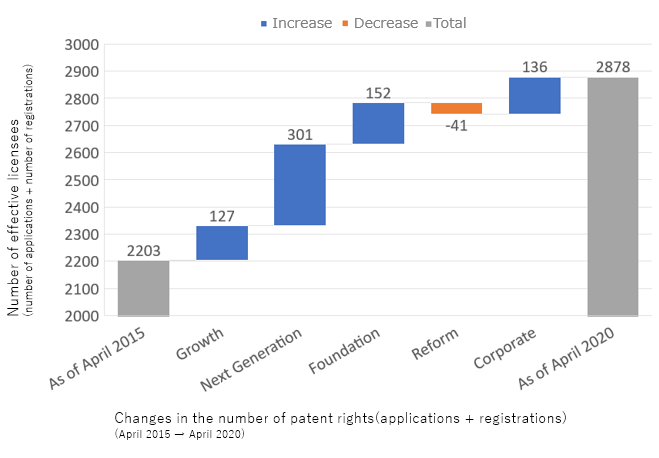
Over the past five years, the total number of patents held by the Daicel Group has increased from 2,203 to 2,878, and we are continuing to maintain our investment in intellectual property. Categorized by business area, the number of patents held related to corporate development - which includes technological development aimed at creating societal value as set forth in our Long-term Vision - as well as biomass product trees and the realization of carbon and energy offsets increased by 564 over the past five years. Looking to net sales and operating income, we will also prioritize resource allocation to increase the proportion of business categorized as Next Generation and Growth. We also intend to further expand our intellectual property rights as we work to implement Daicel Vision 4.0 as a means of securing a degree of business freedom.
Enhancing our Approach of “Co-creation”
Daicel aims to develop partners with whom we can create value while sharing our philosophy as we seek to transcend the limitations of corporations and industries. In terms of investing in intellectual property and intangible assets, we are actively engaged in joint development that embodies our philosophy. One of these initiatives is our effort to establish a biomass value chain. We have therefore formulated Daicel Vision 4.0, our fourth long-term vision, according to the terms of our Sustainable Management Policy. By developing technologies friendly to people and the environment, we aim to contribute to the emergence of a society committed to sustainability. As part of this effort, we are promoting the effective use of natural resources, such as cellulose (which Daicel has dealt with for many years) from our new biomass product trees, thus leading to a shift away from petroleum.
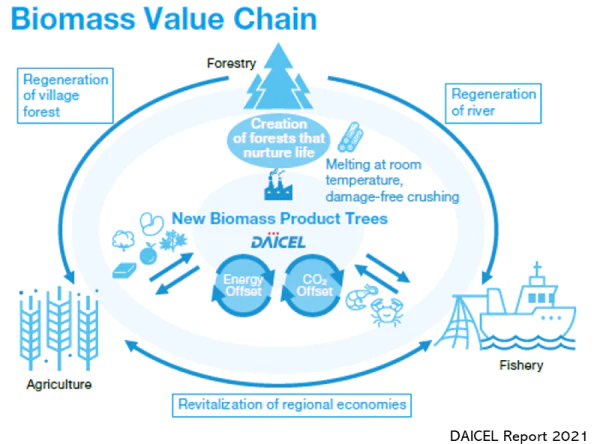
We are increasing our investments in technological development while working with Kanazawa University and Kyoto University as a form of collaboration between industry and academia. Through this approach, we are steadily accumulating intellectual property rights that have resulted from our investment in technological development.
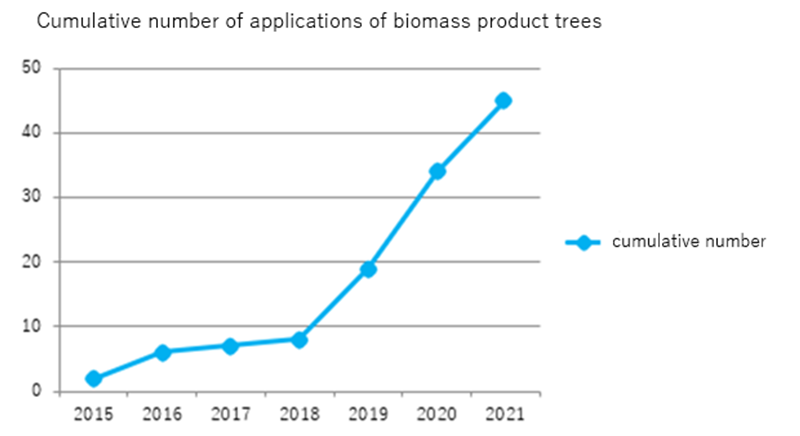
In order to establish a biomass value chain, we believe we must address various issues, regardless of the specifics of a particular supply chain, through collaborations involving industry, academia, and government while gathering expertise from areas beyond the scope of industry and academia. As for intellectual property, we intend to increase our intellectual property initiatives as a means of accelerating our ability to develop businesses. We will do so by considering and utilizing intellectual property not for the benefit of individual companies and individual processes, but in order to contribute to the entire supply chain.
Related Links
-
特許庁Webサイト「経営戦略に資する知財情報分析・活用に関する調査研究」
-
IPランドスケープを実践している国内企業として、ヒアリング調査に協力しました。
-
-
株式会社ユーザベース H2H(Home to Home)セミナー「IPランドスケープが変える、「攻め」の経営 ~技術・知財戦略に期待する、ダイセル新中期経営計画の真意~」[PDF:1.57MB]
-
日本弁理士会関西会Webサイト「ちざい げんき きんき」事例紹介