About the Micro Plant ABOUT MICRO PLANT
The Micro Plant,
a revolutionary ultra-low-energy production system
BEFORE Large-scale, high-energy conventional manufacturing method
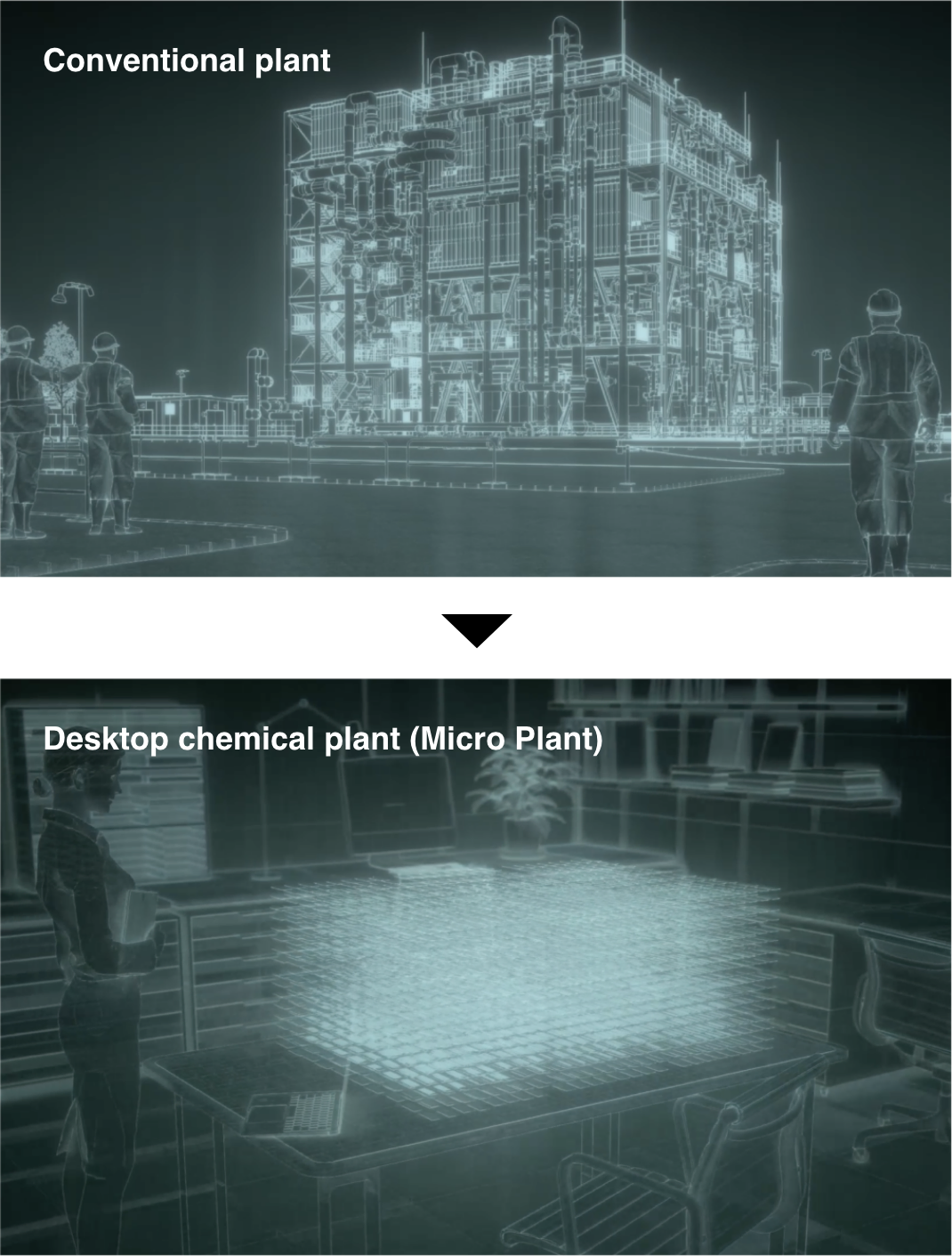
The chemical-making processes in conventional chemical plants use high-energy processes in which large volumes of materials are placed in huge reactors, large amounts of heat and pressure are applied, and molecules react while being heated for long periods of time. In large reactors, the temperature and pressure become uneven, and many undesirable compounds are produced, so additional energy is required to remove them. The “micro plant,” is a technology for making ultra-compact plants by combining single glass plates that fundamentally overturns a process that requires a lot of energy and processes.

AFTER The Micro Plant — the ultimate ultra-low-energy plant
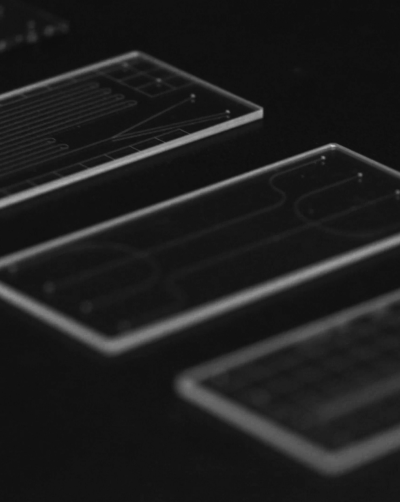
In a Micro Plant, materials flow in approx. 100 μm ultrafine channels (flow paths) extending throughout a 7 × 3 cm glass plate.
Molecules meet with pinpoint precision at an even temperature and pressure, and reactions occur in a much shorter time than before. Furthermore, undesirable components are not generated, and thus a process to remove them is no longer required.
It is the ultimate ultra-low-energy plant that significantly reduces CO₂ emissions by lowering energy consumption and contributes to carbon neutrality.

is converted into a Micro Plant and the industrial revolution that occurs when the entire supply chain is converted into Micro Plants
Converting a conventional resist polymer plant into a Micro Plant
Conventional resist polymer plant process
![Monomer Solvent Monomer dissolution Polymerization reaction Post-processing to increase purity [Purification 1, Purification 2, Purification 3] Product (polymer)](https://data.wovn.io/ImageValue/production/690971b298e5370c28e0024a/en/fe6db249790dcb46cac8c33d8dc83d26/index_im06.webp)
Process after conversion into a Micro Plant
![Microfluidic Devices [Monomers, Solvents, Polymerization Reactions, Products (Polymers)]](https://data.wovn.io/ImageValue/production/690971b298e5370c28e0024a/en/f76f894e1aaf79aa1a33170f431f8592/index_im07.webp)
Additional conversion of the entire supply chain into Micro Plant
Conventional monomer manufacturing process
![Reaction: Increase purity [Purification 1, Purification 2, Purification 3, Purification 4] Monomer: Extraction, crystallization, separation, drying, evaporation, etc.](https://data.wovn.io/ImageValue/production/690971b298e5370c28e0024a/en/b9a4be06b7e29a51d390b2c942e7211e/index_im08.webp)
Conventional solvent manufacturing process
![Reaction Increase purity [Removal of low boiling point and high boiling point] Solvent](https://data.wovn.io/ImageValue/production/690971b298e5370c28e0024a/en/5fd92e321412efc66b519e1d2874fdf2/index_im09.webp)
Supply chain process innovation after full conversion into Micro Plant
![Microfluidic devices [monomer production reaction monomer, solvent production reaction solvent] Microfluidic devices [polymer production polymerization reaction product (polymer)]](https://data.wovn.io/ImageValue/production/690971b298e5370c28e0024a/en/016792ef2fdd462b8ce10d2c9993f647/index_im10.webp)
Three production revolutions of the Micro Plant
01 Microminiaturization revolution
In the case of the Micro Plant, each unit is completed by connecting small glass plates called microfluidic devices in series. By integrating the designs for the glass flow paths, the Micro Plant can handle any chemical product, and the production volume can be increased limitlessly by arranging units in parallel.
For example, a large 20 m × 20 m × 20 m plant can be microminiaturized, even to desktop scale. In addition, when industrializing the results of laboratory experiments, the results can simply be replicated with an increased number of glass plates. Microminiaturization affects not only the scale and production efficiency but also eliminates waste in the research to implementation process.
02 Ultra-low-Energy revolution
In ultrafine flow paths, it is possible to produce targeted reactions quickly with pinpoint precision at an even temperature and pressure. Since wasteful reactions are unlikely to occur, the purity of the product is high, and there is no need for post-processing to separate out undesirable components. This can reduce energy consumption and CO₂ emissions by more than 90%.
03 Production facility revolution
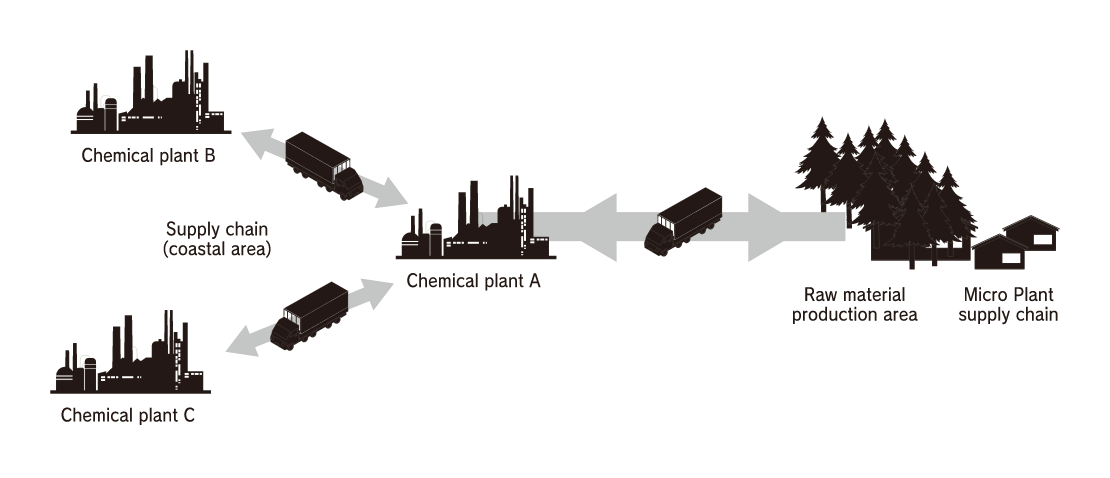
Because the Micro Plant is ultra-small, ultra-low-energy, and low cost, it drastically increases the flexibility of production facilities. If production facilities are located where the raw materials are, local production for local consumption is easier, and the cost and energy required for transportation can be reduced significantly.