Basic Approach
In line with the Daicel Group Basic Policies for Responsible Care , we strive to ensure the safety of our products and promote continuous improvement in product stewardship* across the entire supply chain. At the same time, we practice chemicals management with consideration for risks that arise throughout the product life cycle, from development, manufacturing, distribution, and use to disposal and recycling. We are committed to disclosing the information required for properly handling chemical substances both inside and outside the Group.
-
* Product stewardship is an initiative for minimizing the impact of chemical substances on human health, safety, and the environment throughout the entire value chain related to the life cycle of a chemical product, encompassing its development, manufacture, distribution, use, disposal, and recycling.
Management Structure
Under the Responsible Care (“RC”) Promotion System, spearheaded by the RC Council, the Daicel Group ensures environmental, health, and safety throughout all stages, from chemical development and manufacturing to distribution, use, final consumption, and disposal, and publicly discloses the results in order to engage in dialogue and communication with society. We practice proper chemical substance management by implementing the Total Environmental, Health and Safety (EHS) Assessment System as a means for evaluating risks associated with chemical substances regarding health, safety, and the environment. Chemical substances subject to risk assessment include existing products that have undergone production process or production equipment changes, as well as new products.
Chemical Substance Management
Initiatives to Maintain Compliance with International Chemical Substance Regulations
The Daicel Group not only complies with domestic regulations pertaining to the management of chemical substances but also maintains compliance with the chemical regulations enforced in each country in Europe, the U.S., Asia-Pacific, and other regions by utilizing search databases for domestic and international laws to obtain the latest information on revisions to laws and regulatory trends in each country.
In FY2026/3, we steadily progressed with registration to comply with the regulations of the United Kingdom's UK-REACH, South Korea's K-REACH, and the respective regulations of China, Taiwan region, and the Philippines, all of which are equivalent to the Europe's REACH Regulation.*
-
* REACH (Registration, Evaluation, Authorization and Restriction of Chemicals) is a regulation that mandates that producers and importers must register their chemical products with the European Union, conduct safety assessments, control permits for their use, and restrict their use.
Consolidated Management of Chemical Information
The Daicel Group centrally manages information on the hazardous/dangerous properties of raw materials, intermediates, and products, as well as chemical substance and regulatory information, using a chemical substance information management system.
The Daicel Group creates SDS* and labels to ensure that all of its products are handled safely and securely based on this information, provides timely information to customers, and conducts risk assessments of the chemical substances in its products.
-
* A Safety Data Sheet is a document providing information on the properties and safety of a chemical substance and instructions about its handling.
Provision and Communication of Chemical Information
The Daicel Group provides the following information on chemical substances to ensure that customers can use its products with a sense of safety and security.
| Information disclosed and communicated via the Safety Data Sheet (SDS) and labels |
|
|---|---|
| Information disclosed via chemSHERPA*2 |
|
-
*1GHS stands for Globally Harmonized System of Classification and Labelling of Chemicals, which provides a globally standardized set of rules regarding chemical categories and the presentation of SDS information for hazardous properties of chemical substances, as well as precautions for their handling.
-
*2chemSHERPA is a scheme that aims to ensure the appropriate management of the contents of chemical products while communicating information regarding their ingredients throughout supply chains based on a unified list.
A partial revision of the enforcement ordinance of the Industrial Safety and Health Act (ISHA) was promulgated in May 2022, and substances subject to required labeling, indications using SDS, etc. and notification are added every year since FY2024/3, with approximately 1600 substances added by April 2025. Furthermore, approximately 800 additional substances are scheduled to be added in FY2026/3.
The Daicel Group’s SDS has already been updated to include these substances.
In-House Training and Education
To ensure appropriate management of chemical substances, the Daicel Group regularly provides all workers who handle chemical substances with educational programs about the hazardous properties of chemical substances, appropriate methods for handling them, and the domestic and overseas laws and regulations governing them.
Particularly with respect to domestic and overseas laws and regulations, we have assigned chemical product management supervisors and workers in each business division and Group company, who gather four times a year to exchange information. FY2026/3, the meetings were attended by a total of 180 division heads and relevant staff.
In addition, we provide risk assessment education for all workers who handle chemical substances.
The risk assessment is an extremely important element for chemical substance management, and it is required that evaluators possess broad knowledge and deep understanding in order to properly interpret the assessment results and conduct risk management. The Daicel Group provides opportunities for practical training courses to cultivate professionals who can assess the risks of chemical substances, promoting the acquisition of extensive knowledge and continuous technical skills necessary for risk assessment.
In FY2026/3, we held two training sessions for chemical substance managers on "United Nations Recommendations on the Transport of Dangerous Goods" and the legal framework for the management of chemicals throughout their entire lifecycle, which was attended by approximately 170 people, including those who were not chemical substance managers. We will continue to hold regular training sessions on chemical substance management to further enhance understanding in this area.
Voluntary Efforts Concerning Chemical Substances
When developing new plans* under the Total EHS Assessment System, the Daicel Group conducts advance assessments of all chemical substances handled through its business with regard to the risks and toxicity they may pose in order to prevent people, equipment, and the environment from being affected by its chemical substances.
Prohibited Substances
Prohibited substances are chemical substances whose manufacture and use are prohibited or severely restricted by law due to their hazardous or harmful properties. The Daicel Group has implemented a ban on the manufacture and use of these substances.
Substances Prohibited in Principle
Substances prohibited in principle are chemical substances whose manufacture and use are strictly regulated (requiring permission, notification, implementation of safety measures, etc.). In principle, the Daicel Group prohibits the manufacture and use of these substances and considers replacing them with alternative substances at the research and development stage. If it is unavoidable to manufacture such a substance, we conduct a preliminary review at the Corporate Total EHS Assessment Committee based on information such as its hazards, harmfulness, production volume, usage volume, purpose, exposure situation, and risk measures for people's health and the environment and make a judgment on whether or not the use would be permissible.
As mentioned above, we systematically manage substances of concern for their hazards and harmfulness based on the Total EHS Assessment System.
In addition, we conduct risk assessments for all chemical substances handled in all operations, including the manufacture, development, and testing of not only existing products but also new and developmental products.
-
* This includes expanded applications for existing products as well as changes to product standards, manufacturing methods, and raw materials.
Our Philosophy on Animal Experimentation in Safety Evaluations
In order to develop products and conduct proper chemical management, it is essential to conduct hazard and toxicity assessments, including compliance with national and regional regulations. The Daicel Group believes that it is our corporate social responsibility to accurately understand the impact on human health and the environment while giving maximum consideration to animal welfare.
On the other hand, when animal experimentation cannot be avoided due to current legal regulations or scope of scientific validity, we strictly adhere to the 3Rs,* which are international principles concerning animal welfare. In particular, we outsource testing only to highly reliable institutions that have clear policies regarding animal welfare and whose third-party certifications and appropriate management systems have been verified.
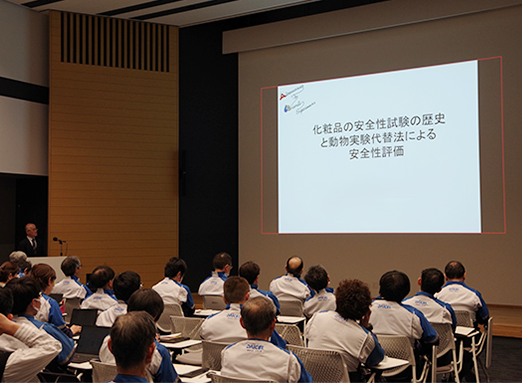
In FY2026/3, we held a lecture titled "Understanding the Current State and Cutting Edge of 'Safety Evaluations Without Reliance on Animal Testing,'" hosted by the Responsible Care Center. We invited two academic experts who have been at the forefront of this field for many years to serve as speakers at this lecture, deepening our understanding of the latest trends in non-animal testing methods based on the 3Rs concept and next-generation safety evaluations. As well as R&D and business divisions, corporate sustainability and governance divisions also participated in this lecture, and we expanded company-wide efforts to reduce animal testing and make it a continuous initiative.
-
* A set of internationally established principles that seeks to ensure animal experimentation is conducted properly, and that includes guidelines for the feeding and care of animals used in experiments. The 3Rs refer to the principles of (1) alleviating animal suffering (Refinement), (2) reducing the number of animals used (Reduction), and (3) using alternative means of experimentation that do not involve the use of animals (Replacement).