
Basic Approach
Our Group follows the Daicel Group’s Basic Policies for Responsible Care to implement a variety of initiatives for reducing environmental impacts, including the preservation of water resources, environmental management of air pollution, reductions in emissions and the appropriate management of chemical substances at all of its business sites. With regard to waste reduction and recycling efforts in accordance with the Japan Business Federation’s “Voluntary Action Plan for Establishing a Sound Material-Cycle Society,” we are further promoting the 3Rs (reduce, reuse, and recycle) to reduce the amount of waste. This includes efforts to save resources, reuse, and recycle as we strive to realize a circular society.
Management Structure
Promotion System for Responsible CareInitiatives to Reduce Waste
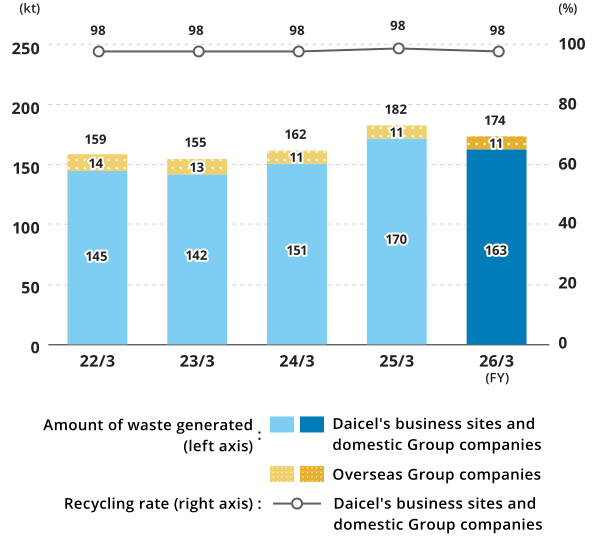
The Daicel Group manufactures a variety of chemical products, and waste is generated in the manufacturing processes. Examples include waste in the form of cinders and particulates from the burning of solid fuels for energy production, waste liquids, cleaning fluids, remnants, defective products, and decommissioned equipment. The Daicel Group strives to achieve zero emissions (with less than 1% of landfill disposal of waste generated) by taking a proactive approach to recycling cinders and particulates that account for about half the waste produced in Japan.
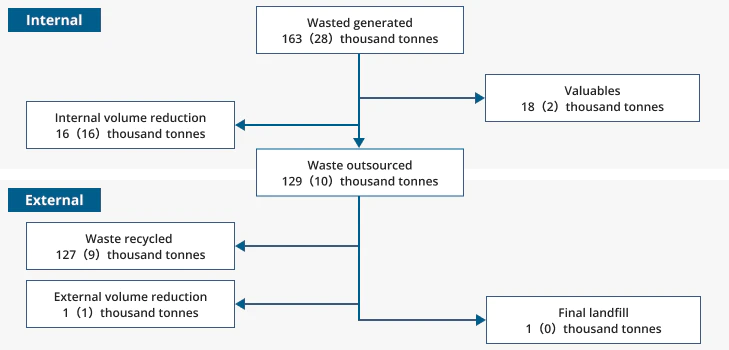
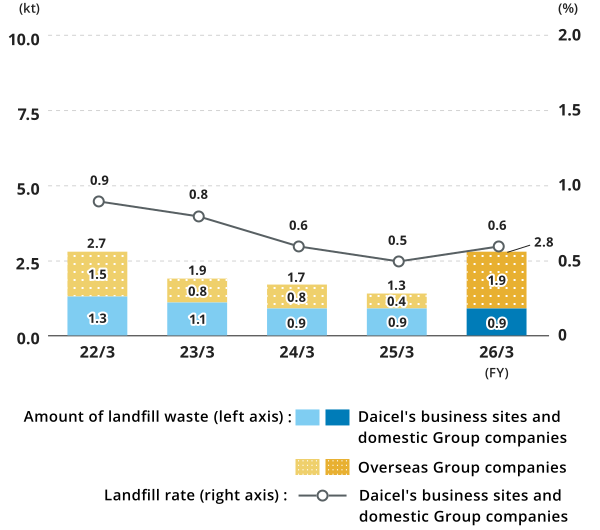
In FY2026/3, the amount of waste generated by Daicel’s business sites and the domestic Group companies decreased by 4.1% compared to the previous fiscal year to 163 thousand tonnes. The recycling rate declined year-on-year by 0.4% to 98.0%. The amount of landfill waste declined year-on-year by 0.1% to 0.6%, but the zero-emission target was achieved.
As a mid-term target with FTY2031/3 as the final year, we have focused on the amount of landfill waste and set a target of 840 tonnes or less, further reducing the FY2026/3 amount of 934 tonnes by 10%. We will continue to make every effort to promote recycling and reduce waste.
Mid-term Target and Results (Daicel’s Business Sites and Domestic Group Companies)
- FY2031/3 Target
- The amount of landfill waste: 840 tonnes or less
- FY2026/3 Results
- The amount of landfill waste: 934 tonnes
Waste Reduction and Recycling Flow in FY2026/3 (Daicel’s Business Sites and Domestic Group Companies)
-
* Numbers in parentheses refer to the amount of hazardous waste
Hazardous waste: waste oil, waste acid, and waste alkalis
Amount of Waste Generated and Recycling Rate
Amount of Landfill Waste and Landfill Rate
Promoting the 3Rs
The Daicel Group pursues the 3R initiatives of reduce, reuse, and recycle, including the conservation of resources, under the Daicel Group’s Basic Policies for Responsible Care.
Major 3R Initiatives
| Reduce | Improve the defect rate for inflators | We seek to reduce industrial waste by modifying the manufacturing facility to lower defect rates for welding and caulking. |
|---|---|---|
| Reduce waste | We seek to reduce industrial waste by introducing a drying process to reduce the volume of deposits with a strong odor, which occurs during wastewater treatment. | |
| Reuse | Reuse palettes for shipping | We promote reuse by switching to palettes that are easier to reuse and by conducting bulk collection of palettes. |
| Reuse containers | We promote reuse by cleansing containers to avoid single use. | |
| Recycle | Recycle boiler slag into raw material for cement and other materials | We select multiple disposal companies to promptly implement recycling. |
| Recycle metals | We recycle metals by sorting waste generated by plant closures. | |
| Recycle inflators | We implement the treatment of explosive waste from the inflators of scrapped automobiles at our facilities, and we sort metals and plastics for recycling. |
Responding to the Act on Promotion of Resource Circulation for Plastics
Plastic Waste Generation Status and Waste Reduction Targets
Our Group includes companies that engage in businesses related to plastics, such as the consumption of plastic products in the manufacturing process, the manufacture of resins that are raw materials for products using plastics, and the processing of plastic parts.
In FY2026/3, the amount of plastic waste generated by Daicel was 2,237 tonnes (decreased by 0.5% compared to the FY2025/3) and 1,570 tonnes (increased by 3.8% compared to FY2025/3) by domestic Group companies for a total of 3,807 tonnes (increased by 1.2% compared to the FY2025/3). Daicel, Polyplastics, Co. Ltd., and Daicel Value Coating Ltd. are classified as large volume generators.
Daicel and domestic Group companies are striving to reduce waste generation by improving yields in manufacturing and processing and by recycling by-products and scraps.
Plastic Waste Generation Status (FY2026/3)
| Company Name | Total amount of waste | Amount of waste recycled | Amount of waste incinerated | Amount of waste sent to landfills | |
|---|---|---|---|---|---|
| Daicel Corporation | 2,237 | 1,860 | 56 | 322 | |
| Domestic Group Companies | 1,570 | 1,153 | 87 | 329 | |
| Polyplastics Co., Ltd. | 615 | 614 | 0 | 2 | |
| Daicel Value Coating Ltd. | 555 | 188 | 39 | 328 | |
| Toyama Filter Tow Co., Ltd. | 234 | 230 | 4 | 0 | |
| Daicel Beyond Ltd. | 92 | 84 | 8 | 0 | |
| Dainichi Chemical Co.,Ltd. | 34 | 0 | 34 | 0 | |
| Others | 39 | 38 | 1 | 0 | |