
Basic Approach
The Daicel Group has set out its Medium- and Long-term Reduction Target for reducing GHG emissions underthe Daicel Group’s Basic Policies for Responsible Care with the goal of realizing a carbon neutral society. We will reduce GHG emissions throughout the Group by significantly reducing energy consumption through a fundamental review of our production processes and the introduction of new technologies, and by switching fuels, optimizing energy consumption, introducing renewable energy sources, and utilizing biomass and recycled materials.
Daicel Group's GHG Emissions Reduction Targets
The Daicel Group 's greenhouse gas (GHG) reduction targets have been approved by the Science Based Targets (SBT) initiative.*1
Daicel Group's GHG Emissions Reduction Targets
Near-term Target
-
By FY2031/3, reduce greenhouse gas emissions from Scope 1 and Scope 2 by 50% compared to FY2019/3.
-
By FY2031/3, reduce greenhouse gas emissions from Scope 3*2 (raw material procurement, fuel and energy procurement, and logistics) by 30% compared to FY2019/3.
Net-zero Target
-
By FY2051/3, achieve net-zero greenhouse gas emissions across the entire value chain. (Reduce greenhouse gas emissions from Scope 1, Scope 2, and Scope 3 by 90% compared to FY2019/3. Remaining emissions will be neutralized.*3)
-
*1The international initiative aimed at medium- to long-term GHG reduction targets for companies, consistent with the Paris Agreement to “hold the average global temperature to well below 2°C above pre-industrial levels” and make efforts to “limit the temperature increase to 1.5°C above pre-industrial levels.”
-
*2The target is to achieve a 30% reduction in total emissions from Categories 1, 3, and 4.
- Category 1
- GHG emissions associated with the production of purchased raw materials, components, products, and services
- Category 3
- GHG emissions from upstream processes such as extraction, refining, and power generation of purchased fuels and electricity
- Category 4
- GHG emissions from upstream transportation and storage related to the procurement of raw materials and products
-
*3*3 Neutralizing residual emissions that cannot be fully eliminated even through reduction efforts aligned with a 1.5℃ emissions pathway, by utilizing forest-based removals and carbon removal technologies outside the value chain.
To achieve carbon neutrality, we formulated a medium-term target in 2021: "50% reduction in GHG emissions by 2030 (based on 2018 levels)."
On April 2026, the Daicel Group's greenhouse gas (GHG) emission reduction targets, which update our previous targets, were validated by the Science Based Targets initiative (SBTi).
Going forward, the Daicel Group will continue to promote initiatives to reduce GHG emissions with a value-chain-wide perspective while striving to balance responses to climate change with sustainable business growth. Through these efforts, we aim to enhance corporate trust and contribute to the creation of a sustainable society.
Promotion System for GHG Emission Reductions
In July 2023, we changed the name of the Energy Strategy Committee to the Carbon Neutral Strategy Committee in order to further accelerate carbon neutral initiatives.
The Energy Strategy Committee is under the direct oversight of the President and CEO. The Energy Strategy Committee is chaired by the officer in charge of the Production Management Headquarters (the General Manager of the Production Management Headquarters), and members include representatives from production, energy supply, and other corporate divisions in Japan. The committee will take the lead in promoting and managing energy conservation for the Group as a whole. At the same time, to achieve our GHG emission reduction targets, the entire Group will promote the building of a circular process that reduces emissions in current production processes and energy use, as well as through the use of innovate technologies.
With the aim of achieving our Medium- and Long-term Reduction Target and in order to propose and carry out appropriate investment plans, we launched an internal carbon pricing (ICP) system in April 2025.
Going forward, we will respond to the emissions trading scheme that will be implemented from FY2027/3, and by participating in GX Future Consortium, GX Future League (Japanese Text Only)and promoting reduction initiatives and investment decisions in an integrated manner, we will further strengthen our efforts to reduce GHG emissions.
Structure of the Carbon Neutral Strategy Committee
![社長を最上位とし、その下にカーボンニュートラル戦略委員会(委員長:生産本部長)3つの切り口[現行生産プロセスにおけるGHG排出量削減 | 実行体制[自律型生産システム実装タスクフォース(人工知能(AI)活用、最適運転、高度予知予測) / 工場省エネアクションチーム(共通の切り口によるGHG排出量削減アイテムの横展開)]・革新的技術によるGHG排出量削減 | 実行体制[マイクロ流体デバイスプラント推進プロジェクト(究極の生産効率を追求したプラント小型化) / 生産技術本部工場・サイト(プロセス革新技術の開発・実証・横展開)]・エネルギー供給部門によるGHG排出量削減 | 実行体制[エネルギー会議(エネルギー施策全般、エネルギー設備のダウンサイジング、エネルギー燃料転換、最適運用の追求)]]](https://data.wovn.io/ImageValue/production/690971b298e5370c28e0024a/en/0a15a5100e150895eb4ea9d91a6c190e/index_im00.webp)
Initiatives for Reducing GHG Emissions
The Amount of GHG Emission Reductions of the Daicel Group
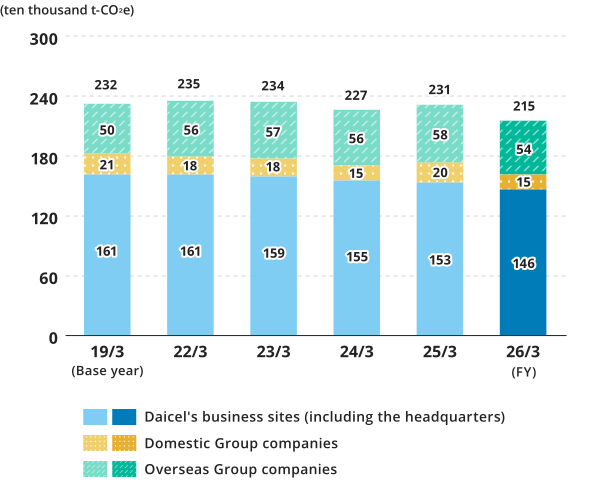
In FY2026/3, GHG emissions (Scope 1, Scope 2) for the Daicel Group decreased by 17 ten thousand t-CO2e from the previous fiscal year to 214 ten thousand t-CO2e (down 7.4% year-on-year). This is broken down into 145 ten thousand t-CO2e (down 5.2% year-on-year) in GHG emissions at Daicel’s business sites, 14 ten thousand t-CO2e (down 28.2% year-on-year) in GHG emissions at domestic Group companies and 54 ten thousand t-CO2e (down 6.4% year-on-year) in GHG emissions at overseas Group companies.
In order to ensure the reliability of the contents of the report, a third party* regularly vouches for our calculations concerning GHG emissions (Scope 1, Scope 2).
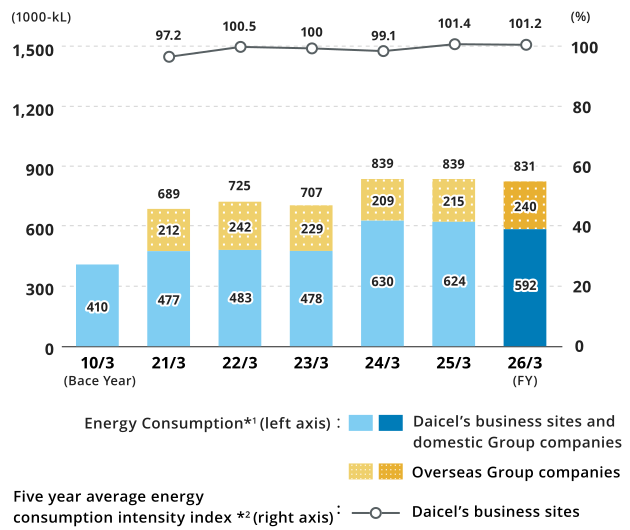
In addition, energy consumption has a major impact on GHG emissions. In FY2026/3, energy consumption for the Daicel Group was the same as FY2025/3, 831 thousand kL in crude-oil equivalent.
In addition, in FY2024/3, we established an issue-specific subcommittee, the Life Cycle Assessment (LCA) Subcommittee, within the Sustainable Management Committee. Utilizing LCA methodology, we calculate the carbon footprint (CFP) of each product and work toward its reduction. Quantitatively visualizing the environmental impact can help us reduce the environmental impact of existing products and develop new environmentally friendly materials and other products.
-
The Company also regularly obtain third-party assurance for Scope 3, but the scope of data calculation of the Scope 3 differs depending on the category.
Energy Consumption
-
*1Only fossil fuels were included until FY2023/3. However, due to the amendment of the energy conservation related laws in Japan, non-fossil fuels have been included from FY2024/3 onwards (converted to crude-oil equivalent).
-
*2This indicator shows how much energy consumption per production volume in unit equivalent has improved on average over a five-year period (less than 100%: improvement, more than 100%: deterioration).
GHG Emissions (Scope1, 2)*
-
Up to FY2026/3, we have calculated GHG emission based on the "Act on Promotion of Global Warming Countermeasures" (hereinafter referred to as the Global Warming Countermeasures Act). With the approval of the Science Based Target (SBT) initiative, we plan to publish data based on the GHG Protocol standards starting from FY2027/3.
Reducing GHG Emissions across Daicel’s Supply Chain
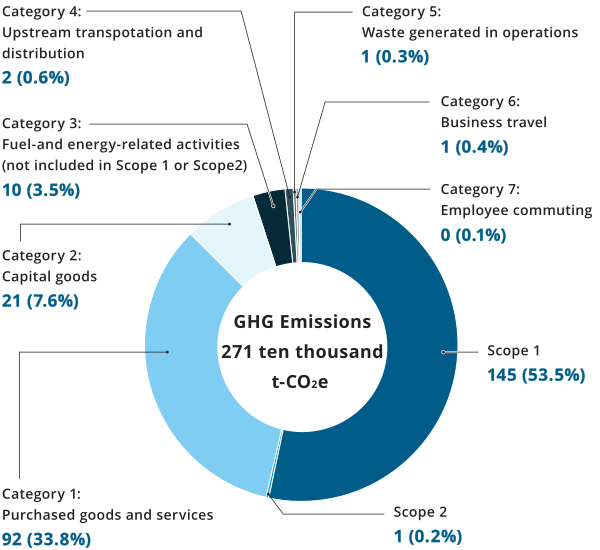
To meet the requirements associated with the approval of the Daicel Group’s GHG emissions reduction targets by the Science Based Targets initiative (SBTi), we plan to disclose GHG emissions data from FY2027/3 onward in accordance with the GHG Protocol. The Scope 3 disclosure will be expanded to cover all categories, and the scope of data calculation boundary for each category will be aligned to cover the entire Daicel Group.
GHG Emissions by Scope in FY2026/3
| Category | Emissions (ten thousand t-CO2e) | ||
|---|---|---|---|
| Scope 1*1 | Direct GHG emissions | 145 | |
| Scope 2*1 | Electricity indirect GHG emissions | 1 | |
| Sum of Scope 1, 2*1 | 145 | ||
| Scope 3 | Other indirect GHG emissions | 125 | |
| カテゴリ1※2 | Purchased goods and services | 92 | |
| カテゴリ2※3 | Capital goods | 21 | |
| カテゴリ3※2 | Fuel- and energy-related activities (not included in Scope 1 or Scope 2) | 10 | |
| カテゴリ4※2 | Upstream transportation and distribution | 2 | |
| カテゴリ5※2 | Waste generated in operations | 1 | |
| カテゴリ6※4 | Business travel | 1 | |
| カテゴリ7※4 | Employee commuting | 0 | |
| Sum of Scope 1, 2, and 3 | 271 | ||
-
*1Daicel's business sites (including the headquarters)
-
*2Daicel's business sites
-
*3Daicel Group
-
*4Daicel's business sites and domestic Group companies
Calculation Methods
Based on the Ministry of the Environment and METI’s Basic Guidelines on Accounting for Greenhouse Gas Emissions Throughout the Supply Chain (Ver. 2.8), we used the guideline’s Emissions Unit Values Database for Accounting of Greenhouse Gas Emissions, etc., by Organizations Throughout the Supply Chain (Ver. 3.6), AIST-IDEA, for life cycle analysis, and emission factors in the calculation, reporting, and publication system for the Law Concerning the Promotion of the Measures to Cope with Global Warming, etc.
Initiatives to Reduce the Environmental Impact of Logistics Operations
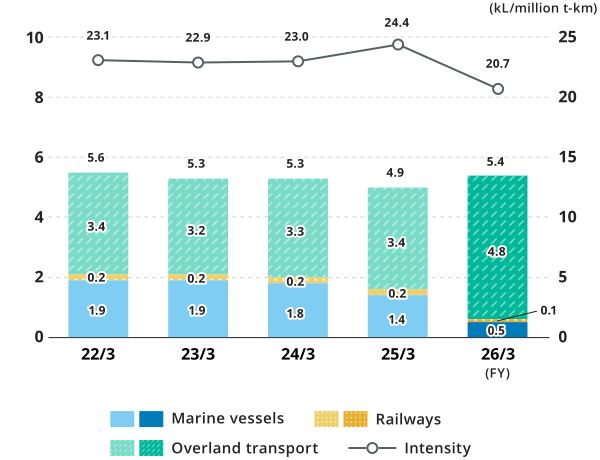
The Daicel Group is striving to curb energy consumption associated with product transportation through initiatives that include promoting a modal shift*1 and container round use.*2 In FY2026/3, the amount of energy used for logistics was 5.4 thousand kL, an increase of 9.7% from the previous fiscal year.
-
*1Shifting freight transport currently handled by trucks to more environmentally friendly modes such as shipping or rail transport.
-
*2Reusing the same container for export that was used for import.
Energy Consumption and Energy Consumption Rates in Logistics Operations (Daicel’s Business Sites and Domestic Group Companies)
CO2 Emissions / Intensity (Daicel’s Business Sites)
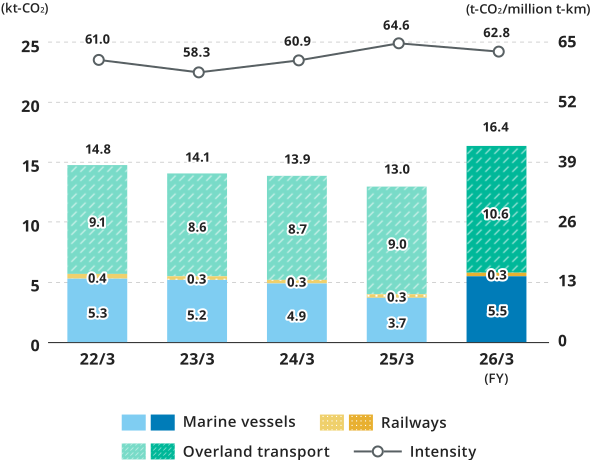
Reduction in Transport CO2 Emissions from the Modal Shift and Other Measures
In 2007, Daicel Logistics Service switched from road to sea transport between the main ports for imports and exports and Daicel’s plants in order to reduce CO2 emissions generated from logistics. In addition, we have reduced the transportation distance and CO2 emissions by changing the ports for exports to ports located near our plants. In FY2026/3, we reduced CO2 emissions to 74% of those for land transportation through modal shifts, including the use of about 6,600 containers* per year for marine transportation.
-
* Calculated on the basis of 40-foot containers.
Promoting Container Round Use
Reusing imported goods containers for exporting products can reduce CO2 emissions associated with the transport of empty containers. Daicel Logistics Service Co., Ltd. has adopted the round use method for containers for export and import operations to further reduce CO2 emissions. This also saves energy by realizing smooth, efficient transport based on its proprietary system for facilitating the matching process for each shipping company. In addition, we strive to ensure safe and efficient transport by reviewing the standards for container use and implementing simple repairs as needed.
Reducing GHG Emissions from Three Angles
The Daicel Group has responded to climate change through the building of a circular process, which will enable us to run our business in harmony with the global environment from the three aspects of reductions in GHG emissions: reductions in GHG emissions in current production processes, innovative technology, and the energy supply divisions.
Reductions in GHG Emissions in Current Production Processes
Energy consumption by the Himeji Production Sector and Ohtake Plant accounts for 90% of overall consumption at Daicel’s business sites. We treat these as if they were a single factory in cyberspace (a virtual factory*) and centrally manage information related to their manufacturing processes. Furthermore, optimal operation, considering quality, cost, and the environment, is achieved through an autonomous production system, which has been advanced by artificial intelligence (AI) developed in joint research with the University of Tokyo based on the Intellectual and Integrated Production System constructed through DAICEL Production Innovation. We have been steadily implementing this technology in our key acetyl chain plants.
In FY2026/3, we are sequentially launching initiatives for multiple organic synthesis plants, starting with peracetic acid derivatives. We plan to expand these efforts to major plants across the company during the next Mid-term Management Strategy period (until FY2031/3), aiming to reduce GHG emissions.
-
*A factory model virtually created in a computer as if it were the real thing.
Introduction of the Energy Operation Optimization System
In order to manage our energy consumption in accordance with the optimal manufacturing plan, we have introduced the Energy Operation Optimization System, which provides online monitoring and controls for the most favorable operating conditions based on actual operating conditions and simulations. This system is used by the Himeji Production Sector and Ohtake Plant.
Leveraging the Self-Consignment System
As part of optimizing energy supply and demand, the Ohtake Plant started sending excess generated electricity to other worksites in West Japan using the self-consignment system. Furthermore, the plant began sending electricity to the Arai Plant in East Japan in May 2020, to the Fuji Plant in April 2021, and to the Kameoka Plant of Daicel Beyond Ltd. in April 2026. We expect to further extend the system to other Group companies toward achieving zero purchased electricity at the Group level.
The Self-Consignment System
![バーチャルファクトリー[大竹工場・姫路製造所] 主力製品、酢酸セルロースを製造(2工場の異なるエネルギー設備の違いを考慮し、必要生産量を基に、エネルギー・在庫・物流などを考慮した最適な生産計画やエネルギー運転条件をシミュレーションできる仕組みを構築) バーチャルファクトリーから西日本(播磨工場、神崎工場、イノベーション・パーク、ダイセルビヨンド亀岡工場)・東日本(新井工場、富士工場、富士研究開発本部)に対して電力自己託送。東日本(グループ企業)に対してさらなるグループ企業への展開を検討。](https://data.wovn.io/ImageValue/production/690971b298e5370c28e0024a/en/df8f5eda8f4f10995747775d3772eab7/index_im06.webp)
Reduction in GHG Emissions by Innovative Technology
The Daicel Group looks well beyond efforts to improve and refine its technologies when putting in place energy-saving measures. It also works to comprehensively review its production processes and develop new technologies to reduce its GHG emissions. The R&D costs for environmental load reduction in FY2026/3 were ¥1,037 million.
In general, distillation processes tend to account for around 40% of general energy consumption in the chemicals industry. This is also true for Daicel’s operations, so establishing energy-saving technologies in distillation processes is key to achieving significant energy savings. The distillation process utilizes high-temperature thermal energy but also generates large volumes of low-temperature exhaust heat energy that is released unused. With this in mind, it is essential to also develop technology that effectively recovers and reuses low-temperature exhaust heat energy in addition to reducing high-temperature thermal energy use.
The Daicel Group has launched an innovative energy-saving technology project and has been promoting cross-sectional activities throughout every level of the Company. As a result, these efforts have led to the creation of a modified Petlyuk process and vapor recompression (VRC) technology to reduce the energy consumption of distillation towers. Although these basic technologies have been used in industrial processes for a long time, they have not been scaled up for use in large chemical plants, with Daicel being the first in the world to do so.
Moreover, we are engaged in joint research with several universities to establish the technology for melting wood under mild conditions (which requires less energy) for constructing new biomass product trees that hold the key to a carbon-neutral future. In addition to implementing measures to reduce CO2 emissions in the manufacturing process, Daicel is developing technology that uses nanodiamonds to convert CO2 into CO for reuse, with the aim of further reducing CO2 emissions that would otherwise be released into the atmosphere.
Enhancing Our Current Technologies
Modified Petlyuk Distillation Process
Petlyuk distillation, and its practical application as a dividing-wall column (DWC), is widely recognized as an energy-saving technology. However, implementing a DWC requires the complete replacement of distillation towers since it cannot be retrofitted to existing facilities, resulting in massive amounts of initial expenditures for the installation. By refining Petlyuk technology, Daicel developed a new process technology that allows for its application through improvements to distillation towers. Since 2014, the technology has been applied at the Arai Plant’s acetic anhydride manufacturing facilities. We are also considering introducing this technology to other plants in order to achieve carbon neutrality.
Vapor Recompression (VRC) Technology
Expectations are mounting that VRC technology will become ubiquitous to recover heat as high-temperature steam by compressing the exhaust heat inherent in low-temperature steam. While this technology has been widely used in aqueous-system simple distillation processes, there have been no examples of its application in organic solvent distillation processes. Aiming to do just this, Daicel has been working with a compressor manufacturer to develop a compressor that would enable the use of VRC technology in organic solvent distillation processes. We have completed verification using a prototype distillation process, and we are currently continuing verification through long-term operations. We are also considering horizontal deployment to other facilities.
-
![VRC技術[蒸留塔の中に、圧縮機(ガス圧縮により高温化)と熱交換器が配置。] 経済産業省 先端設備等投資促進補助事業、改良型ペトリューク技術[反応液から低沸・製品・高沸] VRC技術と改良型ペトリューク技術により、30パーセント以上の省エネ。](https://data.wovn.io/ImageValue/production/690971b298e5370c28e0024a/en/36db39ea370742f46984a8475e74cd2f/index_im08.webp)
New Technologies That Adapt to Environmental Change
Membrane Separation Technology
The evaporation process in distillation consumes massive amounts of energy. Dramatic energy savings, however, are possible if a membrane separation technology is used instead. We are developing membrane separation technology through industry-academia collaborations and are currently conducting demonstration experiments at the Aboshi Plant.
New Reaction Technology
We developed an innovative process, which leverages a newly developed reaction technology with a new catalyst. It has been installed at the Aboshi Plant’s 1,3-BG facility. Energy consumption is reduced by approximately 20% compared to that of conventional technologies.
Cleaning and Extraction Technology Using Supercritical Fluids
Carbon dioxide becomes a supercritical fluid under sufficiently high temperature and pressure conditions. In this state, it exhibits both solvating power like an organic solvent and high diffusivity like a gas. By utilizing supercritical carbon dioxide in existing production facilities, we expect to eliminate the use of organic solvents and reduce steam consumption in solvent-recovery operations. We are currently conducting validation experiments to evaluate these potential benefits.
New Wastewater Treatment Technology (High-efficiency Aerobic Wastewater Treatment Technology)
High-efficiency aerobic wastewater treatment technology improves improves oxygen utilization efficiency, enabling the treatment of high-strength wastewater with lower energy consumption than conventional activated sludge processes. It is expected to downsize the wastewater treatment facilities and lower electricity consumption per unit of BOD removed. We are planning a demonstration trial at the plants to evaluate its performance and practical applicability.
Appropriate Production Technology with Microfluidic Devices
Microfluidic devices are devices that enable chemical operations, such as blending, reacting, and distilling, on a micro scale. Parallelizing 10,000 or more microfluid devices allows manufacturing methods that have been established through research to be expanded into mass production, and at the same time, one can adjust the amount produced to save space, conserve energy, and save resources, as well as to produce the amount required as needed. This technology will help make sustainable next-generation production plants a reality. We introduced a demonstration facility for resist polymer manufacturing by the end of FY2026/3, and started pilot production in FY2027/3.
Reduction in GHG Emissions in the Energy Supply Divisions
Each of the Daicel Group’s plants generates its own steam and electricity for manufacturing, and we will also seek further energy conservation and reductions in GHG emissions by upgrading their facilities, promoting fuel conversion for boilers and procuring green energy such as renewables.
Energy-Saving and GHG Reduction Measures at Each Plant
| Aboshi Plant | In September 2012, the plant installed a cogeneration system with gas turbines. In June 2019, it started selling its excess electricity. |
|---|---|
| Ohtake Plant | In August 2007, the plant started selling its excess electricity. In July 2016, it installed an additional boiler. Two dual-fuel boilers are run in parallel using a mix of coal and scrap tire chips as fuel. |
| Arai Plant | In January 2017, the plant switched from a coal boiler to a cogeneration system with gas turbines. |
Using Fuel Derived from Scrap Tires to Reduce Fossil Fuel Use
In Japan, roughly 100 million scrap tires, or about one million tonnes, are generated each year, placing a considerable load on the environment. On the other hand, about 30% of scrap tires consist of biomass, including natural rubber, making them a superb energy fuel. Having noticed this characteristic, we carry out thermal recycling at the Ohtake Plant with co-firing of coal and scrap tire chips. The addition of scrap tire chips can reduce the use of fossil fuels and CO2 emissions, so we have been collaborating with manufacturers of power generation equipment, making progress in the improvement of the co-firing rate with scrap tire chips and developing technologies to generate the necessary level of power safely. These efforts have yielded some success.
Moreover, we are promoting recycling through the use of particulates and cinders in cement and roadbed improvement agents, which account for about 61% of the total volume of generated waste and the sorting and collection of plastic waste.
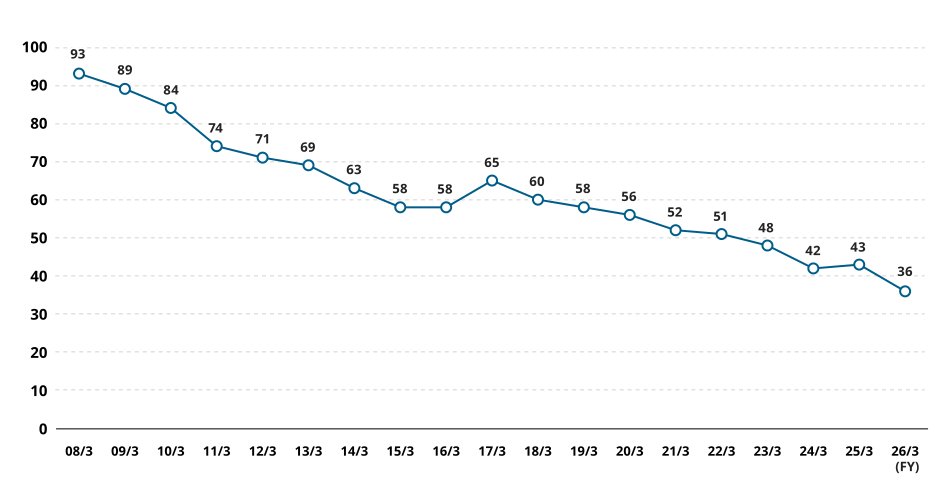
In FY2026/3, we sought to improve the quality control of scrap tire chips used as boiler fuel and achieved a co-firing rate of 63% and a fossil fuel usage rate of 36%. Going forward, we will continue to reinforce our recycling efforts to bring about a sustainable society.
Changes in the Fossil Fuel (Coal) Usage Rate at Ohtake Plant
Reducing Electricity Purchases with Solar Power Generation
We are also actively utilizing renewable energy sources, such as the introduction of solar power generation systems, at Daicel Group production sites. In FY2026/3, the self-generated power from the photovoltaic systems installed at Daicel Safety Systems (Jiangsu) Co., Ltd., Daicel Safety Systems India Pvt. Ltd., Daicel Safety Systems Europe Sp. z o. o., Daicel Safety Systems (Thailand) Co., Ltd. and Daicel Chiral Technologies (India) Pvt. Ltd. totaled 2,441 MWh.
Introduction of Renewable Energy
As part of efforts to help achieve a sustainable society, we have begun introducing renewable energy at the Fuji Plant. Beginning in FY2027/3, we will use a Virtual PowerPurchase Agreement (VPPA)* to cover nearly 10% of annual power needs at the plant. This initiative is expected to reduce CO2 emissions by approximately 5,000 tonnes per year. We aim to gradually introduce it with a view to 2030, promoting efforts to reduce our environmental impact and improve corporate value.
-
* A long-term arrangement for purchasing renewable energy certificates, representing the environmental attributes of renewable energy, from a power generator