
Basic Approach
The risks associated with water, which is one of the irreplaceable natural resources on Earth, are on the rise across the globe. Along with natural disasters such as drought, torrential rain, flooding, and landslides, the water pollution and water shortages arising from people's daily lives and economic activities can also be viewed as water risks.
The Daicel Group adheres to Daicel Group’s Basic Policies on Responsible Care as it seeks to preserve water quality and reduce water use for both fresh and salt water by managing the use of this limited resource and implementing appropriate wastewater treatment.
Management Structure
Promotion System for Responsible CareManaging Water Quality
The Daicel Group manufactures a variety of chemical products, and water is essential to our production processes. For example, we use water in a variety of processes including heating, cooling, and washing, and water is used for equipment that removes and discharges the chemical substances we produce in our production process. We purify the water we use and discharge almost all of it into rivers and oceans.*
At each plant, wastewater is purified to a water quality that can be discharged into rivers and oceans through the stable operation of advanced wastewater treatment facilities, contributing to reducing the environmental impact. In addition to regularly measuring wastewater in accordance with laws and regulations, we also set voluntary targets for wastewater standards and total discharge that are stricter than those required by laws and regulations and strive to preserve water quality by keeping wastewater levels below these targets.
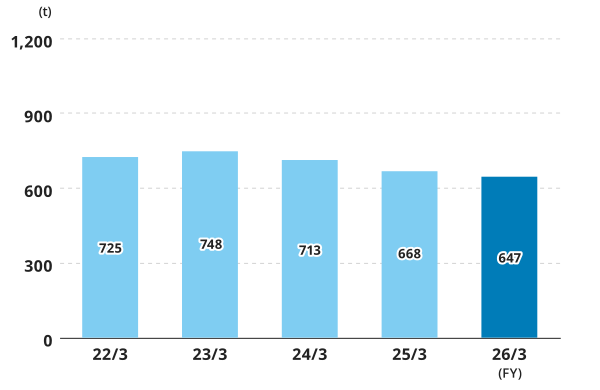
In FY2026/3, we continued proper management based on our voluntarily set targets, and there were no serious legal violations with regard to water resource conservation.
When formulating new business plans, we evaluate the effects of wastewater on water quality in advance by operating the Total Environmental, Health and Safety Assessment System. To fulfill our responsibilities as a manufacturer, we take measures to avoid the risks of water pollution from all causes. This includes improving wastewater treatment facilities in collaboration with facility manufacturers and developing wastewater simulation technology jointly with universities and other institutions. Furthermore, Daicel’s business sites invested 61 million yen in FY2026/3 to strengthen wastewater management.
-
* No discharge into groundwater
COD Emissions (Daicel’s Business Sites and Domestic Group Companies)
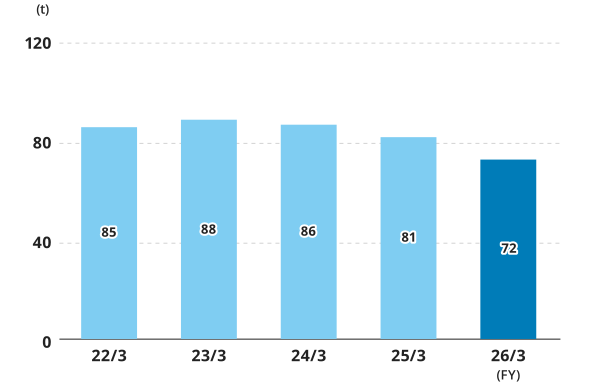
Phosphorous Emissions (Daicel’s Business Sites and Domestic Group Companies)
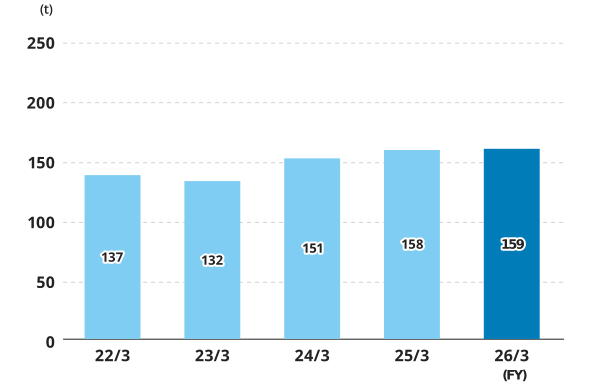
Nitrogen Emissions (Daicel’s Business Sites and Domestic Group Companies)
Efficient Use of Water
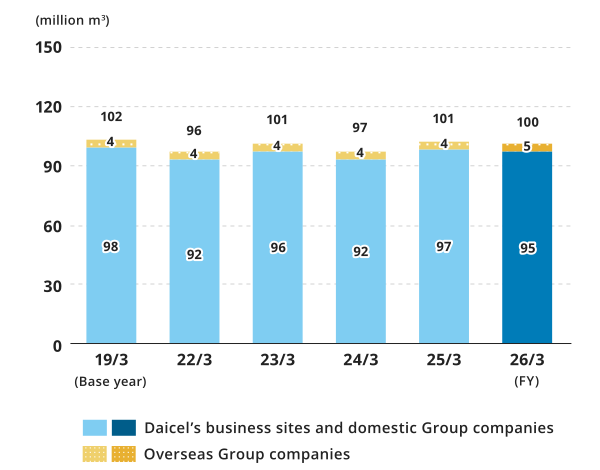
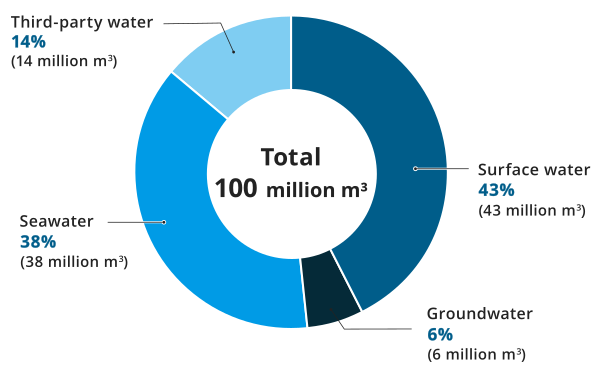
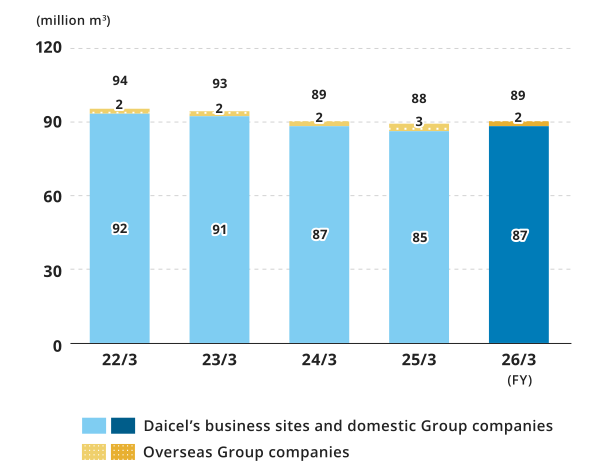
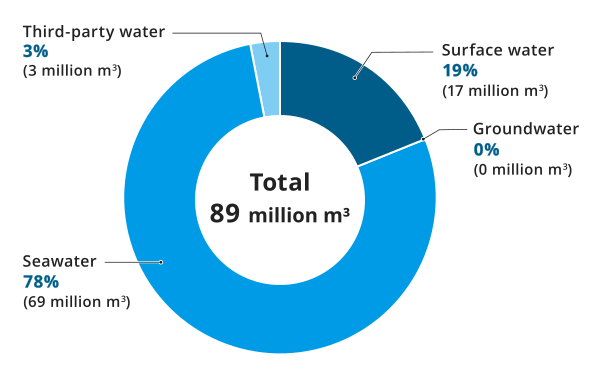
The Daicel Group is promoting efficient water use. Each business site is monitoring water intake, discharge, and water consumption to reduce water risks and to review the manufacturing process, etc., and we are considering expanding these initiatives to other plants.
Since FY2017/3, we have responded to the CDP* Water Security questionnaire, a program for the global disclosure of information concerning water-related risks posed by companies. We received a “B” rating as a result of our responses to the CDP water security questionnaire conducted in FY2026/3.
-
* A British NGO that discloses information on environmental measures taken by companies and local governments.
Water Intake (Daicel Group)
Breakdown of Water Intake (FY2026/3, Daicel Group)
Water Discharged (Daicel Group)
Breakdown of Water Discharged (FY2026/3, Daicel Group)
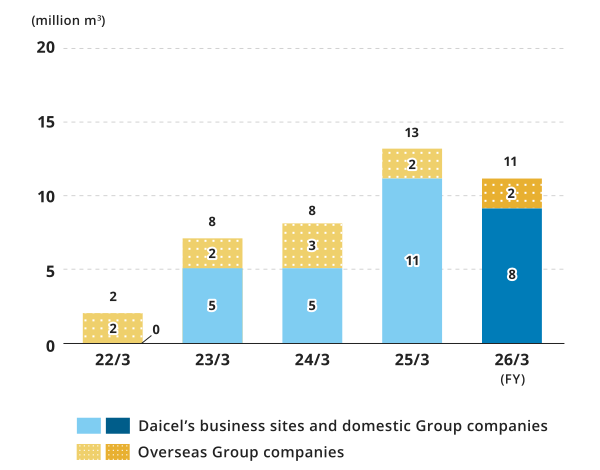
Water Consumption* (Daicel Group)
-
* Water consumption = water intake – water discharge
Assessment of Water-Related Risks
Daicel Group conducts disaster risk assessments on floods and storm surges according to Japan’s Fundamental Plan for Regional Resilience, which strengthen our preparedness for large-scale natural disasters at our production sites in Japan. Overseas, we conduct risk assessments through mapping surveys utilizing Aqueduct*1 and confirming water risk asssesments utilizing WWF Water Risk Filter,*2 and TCFD scenario analysis of major operations. In the water risk assessment conducted in FY2026/3, we identified five business sites exposed to water stress and 12 business sites exposed to flood risk. After confirming their operational conditions and the status of their water risk management measures, we will implement preventive and damage mitigation measures as necessary. Furthermore, in relation to risks affecting business activities, led by the Risk Management Committee, the Daicel Group conducts regular risk assessments for proper identification and management of these risks.
-
*1Aqueduct is a global tool for water risks assessment developed by the World Resources Institute (WRI). This tool makes it possible to assess water risk for site areas in terms of water quantity, quality, regulation, and reputation.
-
*2A global water-risk assessment tool developed by WWF (World Wide Fund for Nature). By entering the location of a site, users can assess water-related risks specific to that area.